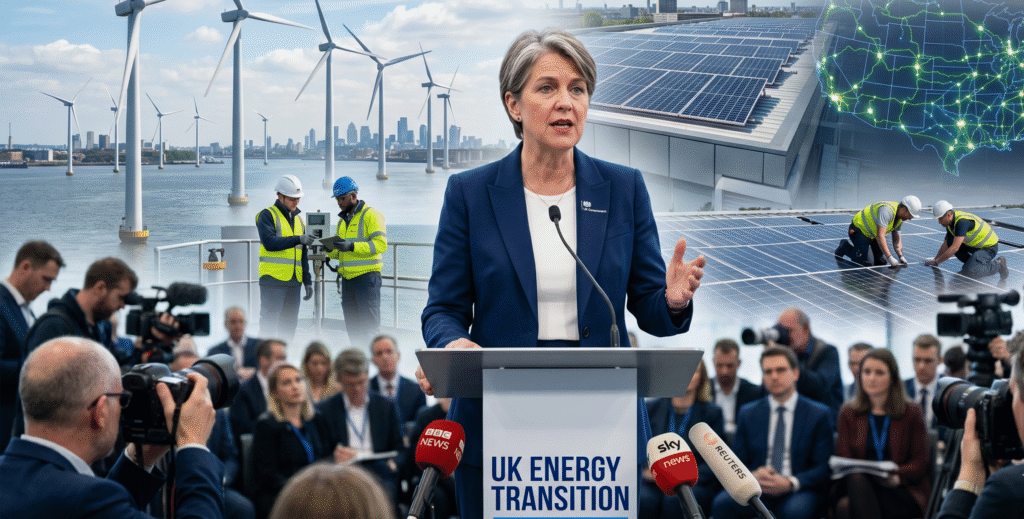
The UK government has renewed its commitment to reaching net zero emissions, presenting climate action as a major driver of economic growth and job creation.
Energy Secretary Ed Miliband said the country should continue investing in clean energy to strengthen the economy and create future employment opportunities. His comments came during a climate-focused event in London.
Clean Energy Positioned as an Economic Opportunity
Miliband said the transition to clean energy should not be treated as an economic burden. Instead, he described it as an opportunity to attract investment and strengthen industrial development.
The government believes stable climate policies encourage businesses to invest with confidence. Renewable sectors such as offshore wind, solar power, and electricity infrastructure continue to receive growing attention.
Recent discussions show that the UK has attracted more than £100 billion in private investment connected to clean energy initiatives during the current parliamentary term.
Investment Growth Creates Employment Opportunities
Supporters of the government’s approach say clean energy expansion already supports economic development.
Large renewable projects continue to create skilled jobs across engineering, construction, and technology sectors. Many regions are also benefiting from new investment and infrastructure upgrades.
Industry supporters argue that long term climate planning gives businesses more certainty and helps generate sustainable employment.
Government Warns Against Slowing Net Zero Progress
Miliband also warned against weakening climate commitments.
He said delaying net zero targets could increase future energy costs and reduce economic momentum. According to the government’s position, expanding domestic clean energy improves energy security and lowers dependence on global fossil fuel markets.
Officials believe stronger renewable capacity can make the country more resilient to international price fluctuations.
Climate Policy Continues to Face Debate
Despite government support, the UK climate agenda remains politically contested.
Some opposition leaders and industry groups have questioned the speed of the transition. They have raised concerns about its effect on traditional energy industries, including North Sea oil and gas operations.
Critics argue that stricter environmental policies may place pressure on local economies connected to fossil fuel production.
Green Economy Seen as a Long Term Growth Engine
Climate economists and policy specialists continue to support the transition strategy.
Research suggests the UK green economy now supports more than one million jobs. Many of these positions offer competitive wages compared with national averages.
Government leaders continue to frame net zero as both an environmental responsibility and an economic development strategy.
As renewable investment expands, discussions about the pace and cost of transition are expected to remain central to future policy decisions.
About The Author