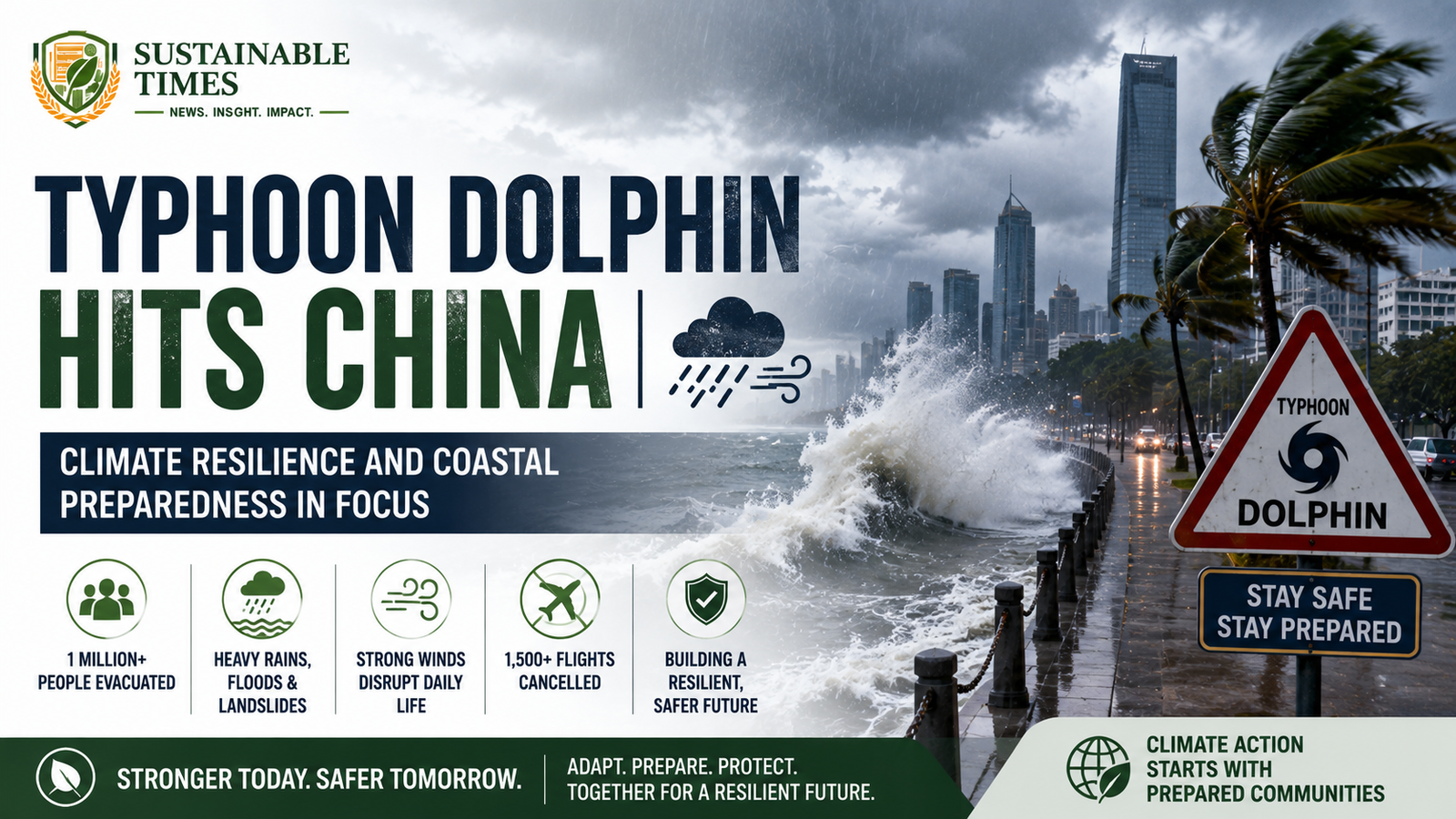
Typhoon Dolphin has made landfall in eastern China, bringing powerful winds, torrential rainfall and widespread disruption while forcing authorities to move more than one million people from high-risk areas. The storm has renewed attention on the growing importance of climate resilience as cities and infrastructure face increasingly complex extreme-weather risks.
The storm reached eastern Zhejiang on August 9 with sustained winds of around 151 km/h, making Dolphin the strongest tropical cyclone to strike China so far in 2026. Heavy rainfall and flood risks have affected Zhejiang, Shanghai, Fujian and Jiangsu, while authorities have also warned of landslides and rising river levels.
A Major Test for Urban Resilience
Shanghai experienced significant disruption as torrential rain caused flooding and forced authorities to suspend some transport services. More than 1,500 flights were cancelled in Shanghai during the storm’s approach, while emergency measures were introduced across affected regions.
The scale of the disruption highlights a growing challenge for rapidly urbanizing regions: extreme weather can affect far more than individual communities. Transport networks, electricity systems, businesses, supply chains and critical infrastructure can all face simultaneous pressure during major storms.
For sustainability planners, this makes climate adaptation increasingly important alongside emissions reduction.
Beyond the Storm: The Climate Connection
Scientists continue to study how climate change affects tropical cyclones. Warmer oceans can provide more energy for storms, while a warmer atmosphere can hold more moisture, potentially contributing to heavier rainfall.
Reuters reported that scientists have linked global warming with the increasing strength of extreme weather events, although individual storms have complex and region-specific causes.
That distinction matters. Climate change does not mean that every individual typhoon results directly from global warming. Instead, scientists examine how a warming climate can change the conditions in which extreme events develop.
Infrastructure Must Adapt
The latest storm demonstrates why climate resilience needs to become part of infrastructure planning.
Cities increasingly need systems capable of managing:
Heavy rainfall: Drainage and flood-control systems must handle increasingly intense precipitation.
Transport disruption: Airports, rail networks and roads need contingency plans that can maintain essential connectivity during extreme weather.
Power resilience: Distributed renewable energy, battery storage and resilient grids can help communities maintain critical services when conventional infrastructure fails.
Early-warning systems: Accurate forecasting and rapid public communication can give communities more time to evacuate or protect critical assets.
Nature-based protection: Wetlands, forests, mangroves and other natural systems can help absorb rainfall and reduce flood impacts when cities protect and restore them alongside engineered infrastructure.
The Sustainability Lesson
Climate action has traditionally focused on reducing greenhouse-gas emissions. That remains essential, but the latest events across Asia demonstrate why adaptation must advance at the same time.
Even if the world succeeds in reducing future emissions, societies will continue to experience climate risks resulting from past and present warming. Governments therefore face a dual challenge: reduce the emissions driving long-term climate change while preparing communities for the hazards already becoming more difficult to manage.
For businesses, this also means reassessing climate risks across supply chains. A storm that temporarily closes a port, airport or manufacturing region can create consequences far beyond the immediate disaster zone.
Looking Ahead
Typhoon Dolphin is moving beyond its initial landfall, but its wider significance will remain relevant long after the storm passes.
As cities expand and extreme weather places greater pressure on infrastructure, resilience will become an increasingly important part of sustainable development. Investments in early-warning systems, resilient infrastructure, renewable energy, efficient water management and ecosystem restoration can help communities prepare for a more uncertain climate future.
The goal is no longer simply to recover after a disaster. It is to design cities, infrastructure and economies that can withstand disruption in the first place.
Key Takeaway
Typhoon Dolphin has exposed the scale of climate and infrastructure risks facing rapidly developing regions. The event reinforces a critical message for the sustainability transition: cutting emissions and preparing for climate impacts must move forward together.
About The Author