Solar power is one of the clearest symbols of the clean-energy transition. Across the world, countries are installing panels at an extraordinary pace, replacing fossil-fuel generation with electricity from the sun.
But there is a less visible side to that success story: what happens to all those panels when they are removed?
Sweden is now confronting that question before the waste wave arrives.
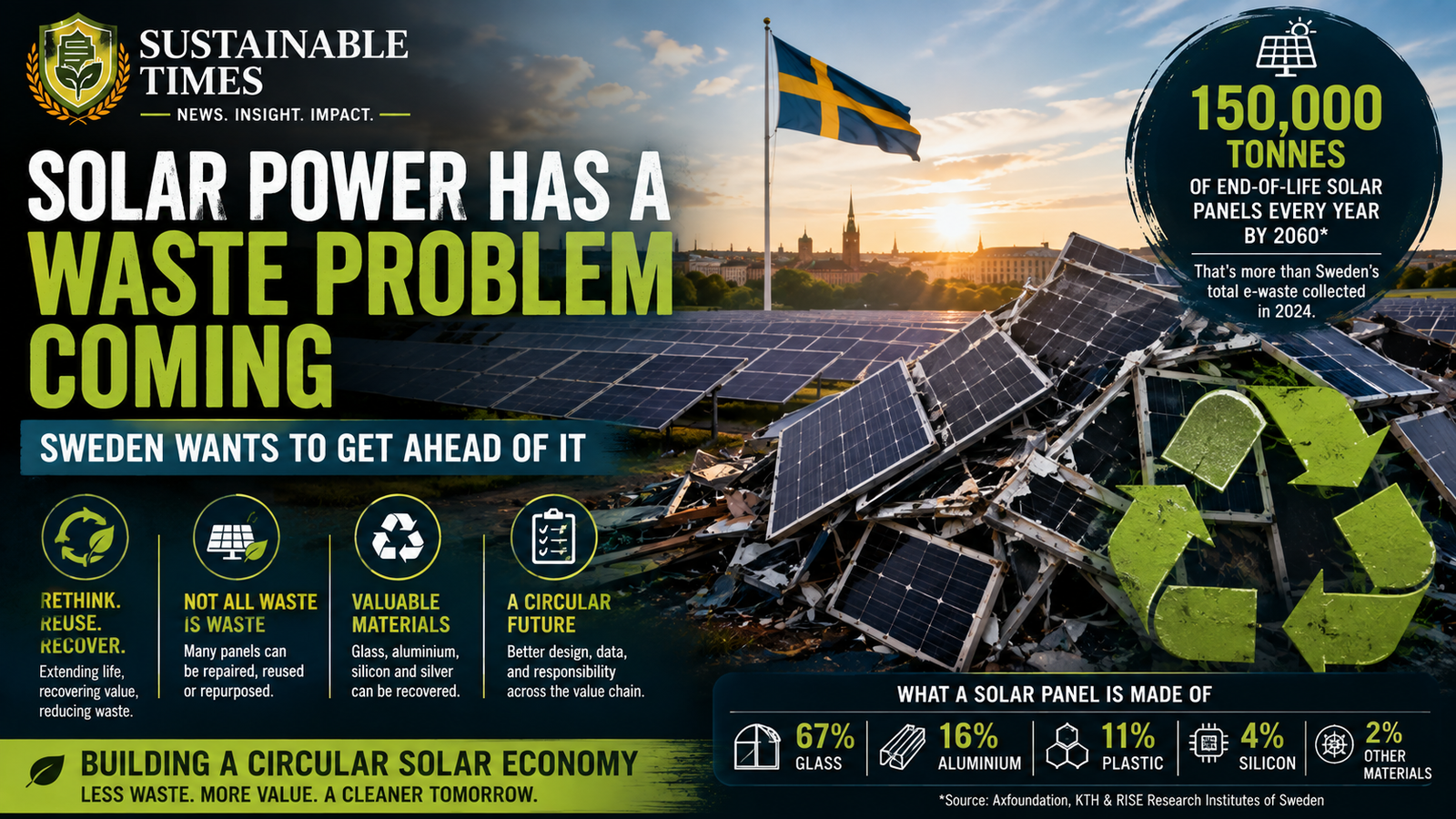
A new circular roadmap developed by the Axfoundation, KTH Royal Institute of Technology and companies across Sweden’s solar and recycling industries warns that the country could have to manage as much as 150,000 tonnes of end-of-life solar panels every year by around 2060. Current estimates put the future annual volume somewhere between 40,000 and 150,000 tonnes, depending on how quickly solar capacity grows and how often existing systems are replaced or repowered.
For perspective, the upper estimate would exceed the total amount of electrical and electronic waste Sweden collected in 2024.
The striking part is that Sweden has barely begun dealing with the problem.
In 2021, the country decommissioned only about 17 tonnes of solar panels. Researchers expect much larger volumes to begin emerging from around 2035 as today’s rapidly expanding solar fleet starts reaching the point where panels are replaced, upgraded or removed.
Not Every “Waste” Panel Is Actually Waste
There is an important distinction behind the numbers.
A panel being removed from a solar installation does not necessarily mean it has stopped working.
Research from KTH’s CircSolar project found that some panels leaving existing installations could still operate, be repaired or be installed somewhere else. Others may never have reached the end of their functional life at all.
That creates an opportunity to rethink the usual path from installation → replacement → waste.
Instead, a more circular system could look like installation → testing → repair or reuse → material recovery.
The difference is significant. Keeping a functioning panel in service preserves the energy and materials that went into manufacturing it in the first place.
Solar Panels Are More Than Glass
A typical photovoltaic panel is largely made from materials that can potentially return to industrial supply chains. The CircSolar roadmap estimates that a typical panel contains roughly 67% glass, 16% aluminium, 11% plastic and 4% silicon, along with smaller quantities of valuable metals such as silver and copper.
That makes discarded panels less like ordinary rubbish and more like a future urban mine.
The challenge is extracting that value economically.
Today’s recycling systems were largely built around existing electronic-waste streams, while solar panels have their own construction, material mix and handling requirements. Sweden’s new roadmap therefore calls for more specialized recycling, better testing for second-life panels and stronger tracking of panels throughout their lives.
The Circular Economy Needs to Start Before the Panel Is Sold
The most interesting message from Sweden is that recycling alone will not solve the problem.
The roadmap calls for action across the entire solar value chain, including longer panel lifetimes, repair and reuse, specialized material recovery, stronger producer responsibility and better data on future panel flows.
That changes how manufacturers and solar developers might think about sustainability.
Instead of designing a panel only around efficiency and price, the industry could increasingly consider how easily it can be repaired, tested, dismantled and recycled decades later.
That is the circular-economy principle in its simplest form: design today’s products with tomorrow’s resources in mind.
And Sweden Is Not Alone
The problem will not stop at Sweden’s borders.
The European Commission’s Joint Research Centre estimates that the European Union could face more than 20 million tonnes of cumulative end-of-life photovoltaic panels by 2050. Globally, the volumes could become much larger as solar deployment accelerates across Asia, North America, Europe and emerging markets.
This means the solar industry’s next sustainability challenge may look very different from its current one.
For years, the central question has been how quickly the world can manufacture and install enough solar panels.
Increasingly, another question is joining it:
Can the industry build a system capable of responsibly managing the panels it installed yesterday?
Turning a Future Waste Stream Into a Resource Stream
Sweden’s approach is interesting because it treats the coming waste challenge as an opportunity rather than simply a liability.
If companies can identify panels suitable for reuse, repair damaged ones and recover high-value materials from those that genuinely reach the end of their lives, the industry could reduce waste while creating new material streams.
That could also make solar manufacturing less dependent on extracting virgin resources.
The transition would require investment, however. Specialized recycling facilities need enough material to operate efficiently, while second-life markets need reliable testing standards so buyers know that reused panels are safe and capable of delivering the expected performance.
The infrastructure has to be built before the waste arrives at scale.
The Bigger Lesson for Clean Technology
Solar power is often described as clean technology, and rightly so when considering its electricity-generation emissions. But no technology exists outside a material supply chain.
Solar panels require glass, aluminium, silicon, plastics and metals. Batteries require minerals. Wind turbines require steel, composites and other materials.
As clean technologies scale, sustainability will increasingly depend on what happens after their first useful life.
Sweden’s solar roadmap offers an early glimpse of that next phase.
The clean-energy transition is no longer only about replacing fossil fuels. It is also about building an industrial system in which the technologies replacing them can themselves become part of a circular economy.
Key Takeaway
Sweden could face up to 150,000 tonnes of end-of-life solar panels every year by around 2060, according to new scenario analysis. The country’s new circular roadmap argues that the industry should act before that wave arrives—extending panel lifetimes, creating stronger reuse markets and developing specialized recycling systems that keep valuable materials in circulation.
The solar revolution is growing. Now its circular economy needs to grow with it.
About The Author