Offshore wind has traditionally depended on one important condition: the seabed must be shallow enough to anchor a turbine.
Floating wind is challenging that assumption.
A new wave of floating offshore wind projects is pushing turbines into deeper waters where conventional fixed-bottom foundations become difficult or impractical. The technology is still expensive and largely at the demonstration or early commercial stage, but its potential is attracting growing attention from developers, governments and investors.
The reason is simple. Some of the world’s strongest offshore wind resources are located far from shore, in waters too deep for conventional foundations.
The turbine doesn’t need to touch the seabed
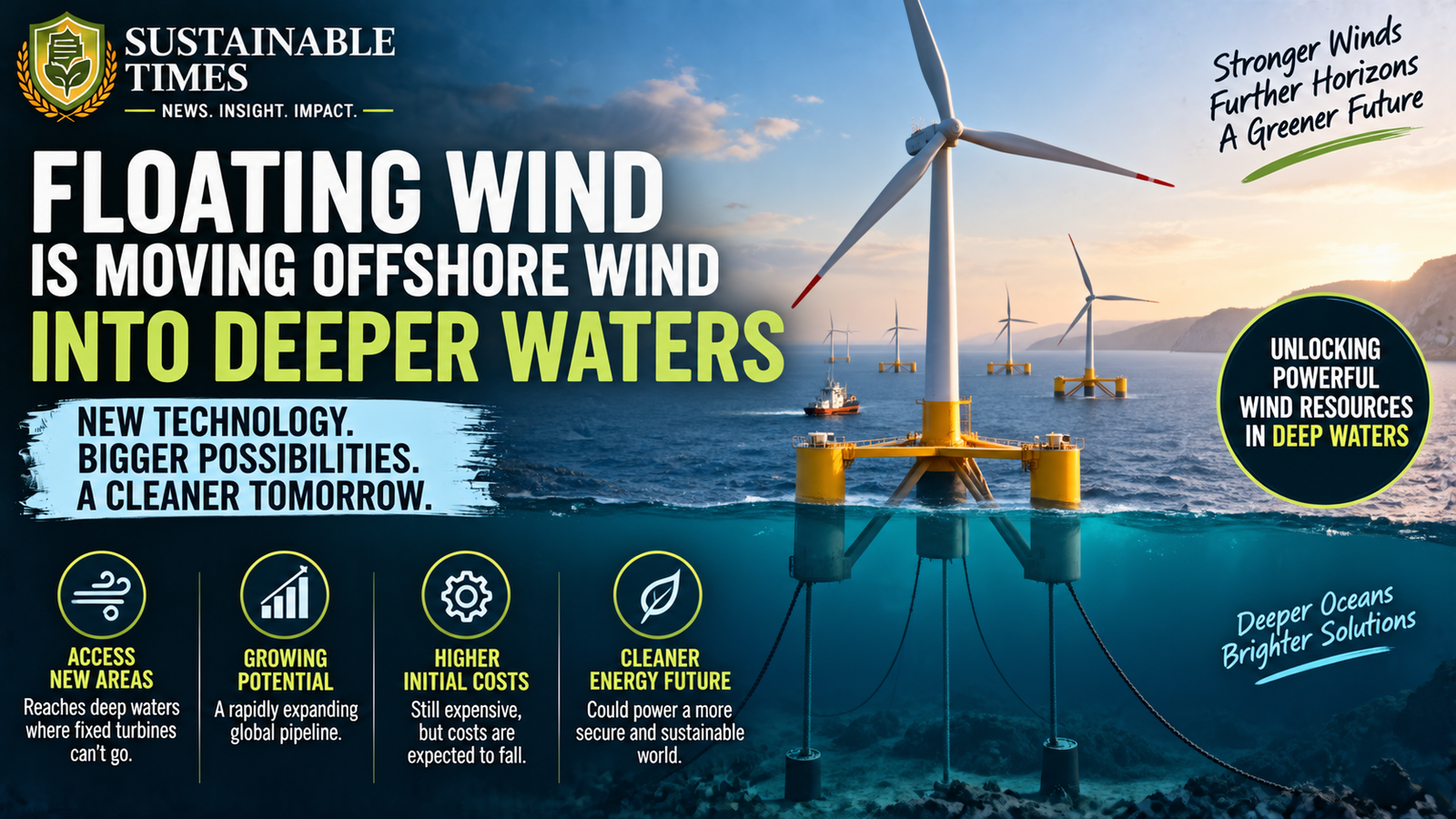
Instead of fixing the turbine directly to the ocean floor, floating wind turbines sit on buoyant platforms that are held in position with mooring systems.
Different designs are being developed, including spar buoys, tension-leg platforms and semi-submersible structures. These platforms allow turbines to operate in water depths where fixed-bottom technology becomes increasingly difficult to deploy.
That could dramatically expand the geographical footprint of offshore wind.
Countries with steep continental shelves or limited shallow-water areas, including Japan and parts of the United States, could particularly benefit from the technology.
The technology is growing, but the economics remain difficult
Floating wind remains a tiny part of the global offshore wind market.
According to the Global Wind Energy Council’s 2026 report, only 278 MW of floating wind capacity had been commissioned worldwide by the end of 2025.
That is minuscule compared with the 92.5 GW of total offshore wind capacity installed globally by the end of 2025.
Cost remains one of the biggest obstacles.
Floating platforms require sophisticated engineering, mooring systems, specialised installation processes and suitable ports. Recent industry analysis indicates that floating projects can currently cost two to four times more than fixed-bottom offshore wind projects, depending on location and project conditions.
For a technology that still needs to scale, that price difference is significant.
Yet the pipeline is getting harder to ignore
The contrast between today’s small installed base and tomorrow’s project pipeline is striking.
Floating wind accounts for a much larger share of planned offshore wind activity than its current operating capacity would suggest. The Financial Times reports that floating wind represents around 22% of the global future offshore wind pipeline, even though it makes up less than 1% of currently installed offshore wind capacity.
But there is an important caveat.
A large pipeline does not mean those projects will necessarily be built.
Recent industry analysis shows that many floating projects still struggle to reach final investment decisions because of high costs, uncertain revenue structures and evolving government support mechanisms. Around 16 GW of floating wind capacity was announced globally in 2025, but commercial deployment continues to lag behind the headline pipeline.
The next stage therefore depends less on ambition and more on bankability.
Why ports and grids could become just as important as turbines
Floating wind is not simply a turbine technology.
Large-scale deployment will require ports capable of assembling and handling massive floating structures, vessels suited to offshore operations, stronger transmission networks and reliable connections to electricity markets.
That infrastructure challenge is already becoming part of the wider offshore wind conversation. GWEC’s 2026 assessment argues that governments need to coordinate offshore wind development with grids, storage, ports and supply chains rather than treating each project as an isolated investment.
This could create another opportunity.
Ports that once supported oil and gas operations could potentially become part of the floating-wind supply chain. Engineering knowledge developed for offshore petroleum infrastructure can also be adapted to floating renewable-energy systems.
There is an environmental question too
Floating wind is not automatically impact-free.
Projects can affect marine habitats, seabirds, fisheries, shipping routes and coastal communities. Mooring systems and underwater cables also introduce environmental considerations that developers must evaluate carefully.
That means scaling floating wind will require more than cheaper technology. Environmental assessment, marine spatial planning and responsible project design will determine whether the technology can expand without simply shifting environmental pressures from one part of the energy system to another.
The World Forum for Offshore Wind has already highlighted the need to consider sustainability as the floating sector develops.
The bigger opportunity
The significance of floating wind goes beyond adding another renewable technology to the energy mix.
If costs fall and supply chains mature, floating turbines could unlock offshore areas that fixed-bottom wind cannot economically reach. That would give countries access to larger wind resources without relying solely on limited shallow-water zones.
The technology is not ready to replace conventional offshore wind. Fixed-bottom projects will continue to dominate deployment for years.
But floating wind could become the next major frontier.
The industry now faces a familiar clean-energy challenge: turn a technically promising technology into an affordable, scalable and environmentally responsible one.
If it succeeds, some of the world’s strongest ocean winds could become a much bigger part of the global clean-energy system.
Key Takeaway
Floating offshore wind remains expensive and relatively small today, but it could unlock enormous deep-water wind resources that conventional turbines cannot easily reach. The next breakthrough will depend on lowering costs, building the right ports and grids, and scaling the technology responsibly.
About The Author