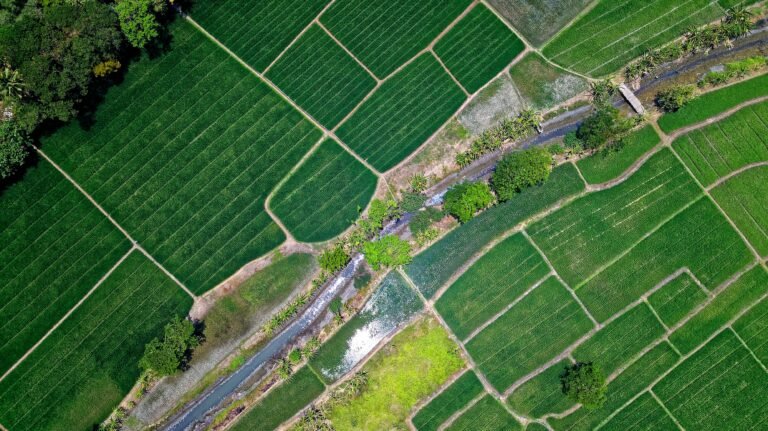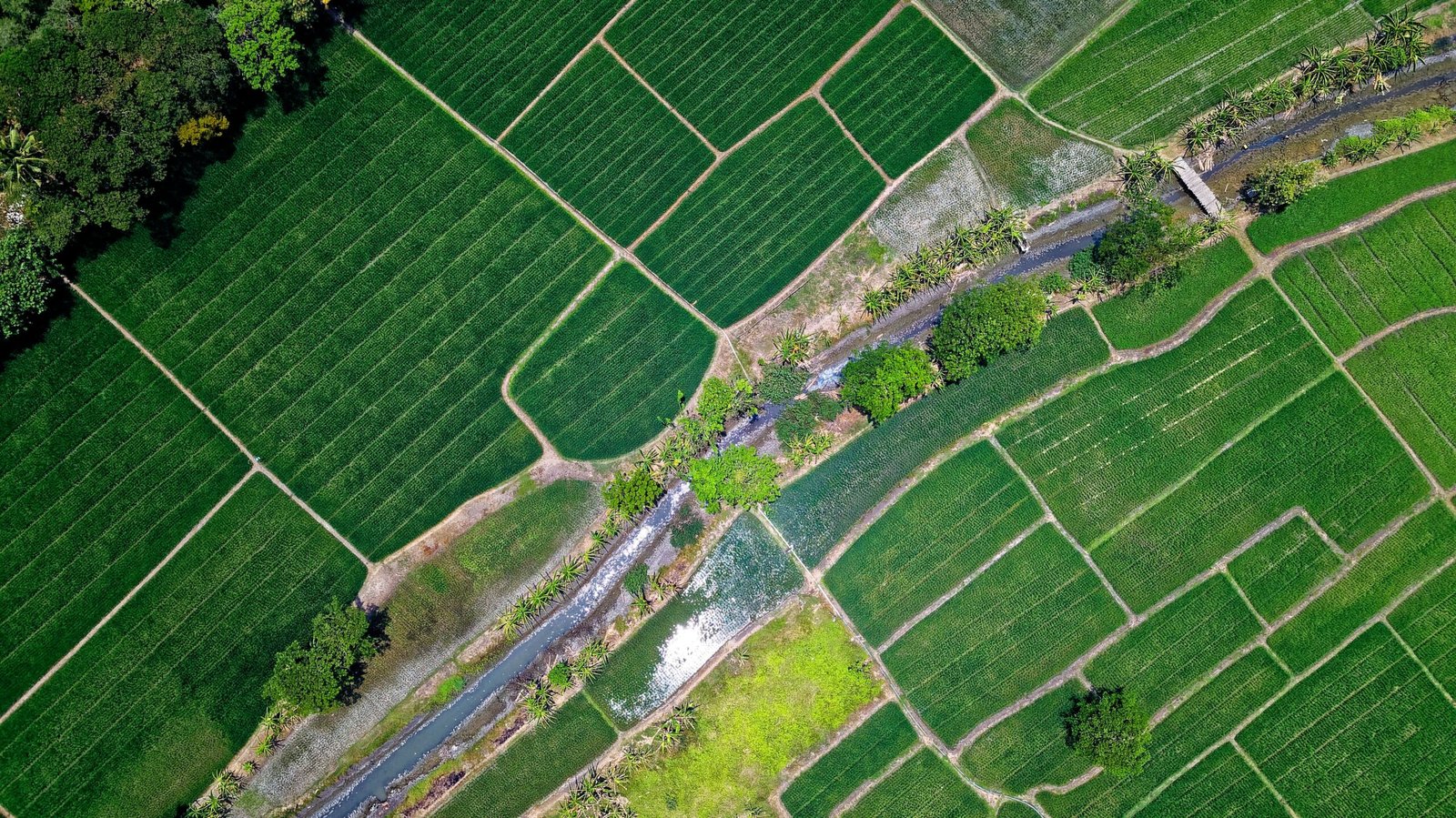
What if a rice field could do more than grow food?
What if the same field could also reduce methane emissions today and gradually pull carbon dioxide out of the atmosphere for decades to come?
That is the idea behind one of the most unusual climate projects announced this week.
Google has reached its largest carbon-removal purchase to date through a partnership with climate technology company Terradot in southern Brazil. The project will work across more than 200,000 hectares of rice farmland, combining two very different approaches to climate action: reducing methane released by flooded rice fields and permanently removing carbon dioxide through crushed volcanic rock.
The interesting part is not simply the size of the project.
It is the fact that the two technologies are being deployed on the same agricultural land.
One is designed to act quickly.
The other is designed to work over a much longer period.
Together, they could offer a new model for turning working farmland into part of the climate solution without taking that land out of food production.
The climate problem hiding inside a rice field
Rice is one of the world’s most important food crops.
But flooded rice paddies also create conditions that allow microorganisms in the soil to produce methane.
Methane does not remain in the atmosphere as long as carbon dioxide, but it has a much stronger warming effect over shorter periods.
That makes methane particularly important when the goal is to slow warming during the next few decades rather than only address emissions far into the future.
Terradot and Google plan to tackle this first through a farming practice known as Alternate Wetting and Drying, or AWD.
Instead of keeping rice fields continuously flooded, farmers periodically allow the fields to drain before flooding them again.
That change in water management can substantially reduce methane production.
And it can also reduce water use.
Google says the Brazilian project will target 1 million tonnes of CO2-equivalent near-term methane impact by 2030.
That gives the project its first climate objective.
But the more unusual part comes next.
Then the rocks arrive
After the rice fields adopt the water-management system, Terradot plans to spread naturally sourced, crushed volcanic rock across those same fields.
It sounds almost too simple.
But the science behind it is fascinating.
Rocks naturally weather when they interact with water and the atmosphere. Certain rocks contain minerals that react with carbon dioxide during this process.
Normally, geological weathering happens extremely slowly.
By crushing the rock into much smaller particles and spreading it across agricultural soil, scientists can dramatically increase the surface area available for these reactions.
This approach is called Enhanced Rock Weathering, or ERW.
As the minerals weather, the process can move carbon from the atmosphere into more stable forms within soil and water systems.
Terradot describes this as accelerating a natural process that would otherwise take much longer.
Google’s agreement targets 1 million tonnes of permanent carbon removal by 2040.
So the project essentially creates two climate timelines.
Methane reduction provides a relatively rapid benefit.
Rock weathering is intended to provide long-duration carbon removal.
Why put both solutions on the same farm?
This is where the project becomes particularly interesting.
Climate policy often separates emissions reduction from carbon removal.
Reducing emissions prevents additional greenhouse gases from entering the atmosphere.
Carbon removal tries to take carbon dioxide that is already there back out.
The Brazilian project attempts to do both.
The methane intervention works on the immediate warming problem.
The enhanced-rock-weathering component works on the longer-term carbon problem.
Google describes this as combining near-term temperature impact with permanent carbon removal within a single agricultural system.
That approach could become important because the world does not have the luxury of choosing between short-term and long-term climate action.
It needs both.
This is not a tiny laboratory experiment
Scale is what makes the announcement noteworthy.
The project covers more than 200,000 hectares of rice farmland in southern Brazil, making it the world’s largest announced enhanced-rock-weathering project, according to Google and Terradot.
That is roughly the point where a climate technology leaves the laboratory and begins facing the messy realities of agriculture.
Farmers have to participate.
Rock has to be sourced, crushed and transported.
Application needs to happen across huge areas.
Soil chemistry varies from field to field.
Weather varies.
Crop yields matter.
Water management has to work for farmers, not just for a climate model.
And every tonne of carbon claimed as removed eventually needs credible measurement.
That last point may become one of the biggest tests of the project.
The measurement problem is just as important as the technology
Carbon removal has attracted enormous interest from technology companies and investors.
It has also attracted scepticism.
The reason is straightforward.
It is relatively easy to announce that a project will remove carbon.
It is much harder to prove exactly how much carbon the project removed, how long that carbon will remain out of the atmosphere and whether the removal would have happened without the project.
Enhanced rock weathering is particularly challenging because the process occurs underground and develops through complex interactions between minerals, soil, water and biology.
Terradot says it uses satellite imagery, environmental data, soil sampling and process-based modelling to measure its projects. Its technology platform also incorporates AI models designed to predict weathering and carbon-removal rates.
That creates an interesting intersection between agriculture, geochemistry, remote sensing and artificial intelligence.
The company says its projects are independently verified through carbon-removal registries including Isometric and Puro.
Still, large-scale deployment will have to demonstrate that measurement remains accurate when the project expands from individual fields to hundreds of thousands of hectares.
The project could eventually reach India
This may be the part that makes the Brazilian experiment particularly relevant to Asia.
Rice is grown across enormous areas of India, Vietnam and other Asian countries.
Google says it hopes the Brazilian project can become a template for replication in other rice-producing regions, including India and Vietnam.
India is especially interesting.
The country is one of the world’s largest rice producers and has millions of hectares under rice cultivation.
If the combination of alternate wetting and drying and enhanced rock weathering proves technically, economically and socially viable in Brazil, researchers could potentially explore similar systems in Indian rice-growing regions.
But copying the Brazilian model would not be straightforward.
Soils differ.
Water availability differs.
Farming practices differ.
Rock resources differ.
Farm sizes differ.
And Indian farmers operate within very different economic and irrigation systems.
The science would therefore have to be adapted rather than simply imported.
There could be a farming benefit beyond carbon
Enhanced rock weathering is attracting interest partly because the minerals released during weathering can affect soil chemistry.
Depending on the rock, soil conditions and application rate, the process may potentially provide agronomic benefits such as improving soil pH or contributing minerals.
But those benefits cannot simply be assumed for every farm.
They depend on the geology, soil and farming system.
That makes field trials important.
Terradot says its technology programme combines extensive soil data with environmental modelling to understand how weathering behaves across different locations.
For farmers, the most compelling version of this technology will not be:
“Help us remove carbon.”
It will be:
“Here is a climate solution that also makes economic and agronomic sense for your farm.”
That distinction could determine whether the technology reaches millions of hectares or remains a niche carbon-removal method.
Google has a reason to look beyond its own data centres
There is also a bigger corporate story behind this deal.
Google’s emissions have been under pressure as the company expands artificial intelligence and the data centres required to run increasingly powerful computing systems.
Carbon removal therefore sits within a difficult challenge for technology companies.
They can purchase renewable electricity.
They can improve data-centre efficiency.
They can reduce operational emissions.
But some emissions remain difficult to eliminate quickly.
That is pushing companies toward technologies capable of removing carbon from the atmosphere.
Google’s new Terradot agreement is its largest carbon-removal purchase so far.
The company is effectively placing a bet on a technology that is still moving from demonstration toward large-scale commercial deployment.
That makes this project more than a climate initiative.
It is also a market signal.
The economics are still the big question
There is one uncomfortable reality behind all the excitement.
Carbon removal remains expensive.
Reuters reported that the cost of enhanced rock weathering remains above the roughly $100-per-tonne level often discussed as an important target for broader adoption.
That means the technology still needs to become cheaper.
Transporting huge quantities of rock is not free.
Crushing rock requires energy.
Applying material across farmland requires machinery and logistics.
Measurement requires scientific monitoring.
And farmers need a reason to participate.
The economics will therefore depend on whether the industry can reduce costs as projects become larger.
This is the same challenge that many clean technologies have faced.
Solar panels became dramatically cheaper as manufacturing scaled.
Batteries followed a similar trajectory.
Carbon removal developers now hope scale, better measurement and improved logistics can produce a comparable effect.
Whether that happens remains uncertain.
A new type of climate infrastructure could be emerging
For decades, climate infrastructure mostly meant things like solar farms, wind turbines, transmission lines and batteries.
Carbon removal adds another category.
It could involve farms.
Forests.
Mineral-processing facilities.
Direct-air-capture plants.
Ocean systems.
Waste streams.
The Brazilian project is interesting because it does not create a separate industrial site dedicated solely to carbon removal.
It puts the climate technology directly into an existing food-production system.
That could be an important direction for the future.
The world cannot dedicate enormous amounts of productive land exclusively to solving climate change.
It still needs food.
It still needs farmers.
It still needs functioning rural economies.
The more climate solutions can operate alongside productive economic activity, the easier they may be to scale.
But this is not a licence to keep emitting
There is a danger in the excitement surrounding carbon removal.
Companies cannot use future carbon-removal projects as an excuse to delay cutting emissions that they can already eliminate.
Removing one tonne of carbon does not make continued fossil-fuel use harmless.
Carbon removal works best as a complement to deep emissions reductions, particularly for emissions that remain difficult to eliminate.
That distinction will become increasingly important as corporations purchase more carbon-removal credits.
The credibility of the sector will depend on proving that removal is genuinely additional, measurable and durable.
Terradot says its projects are designed around additionality, measurement, permanence and independent verification.
Those claims will ultimately need to survive real-world scrutiny at scale.
The rice field may become an unexpected climate laboratory
The most interesting thing about this project is that it changes the way we think about agricultural land.
A rice field is usually viewed through one lens:
How much food can it produce?
The Brazilian project asks a much broader question.
Can the same hectare produce food, use water more efficiently, reduce methane and contribute to long-term carbon removal?
If the answer eventually becomes yes, agriculture could become part of a much more sophisticated climate infrastructure system.
That would not make farmers climate engineers.
It would mean that ordinary farming practices could become connected to a much larger environmental accounting system.
And that could open a new market around climate-smart agriculture.
Brazil is only the beginning
Google and Terradot are presenting the Brazilian project as a model that could eventually expand beyond the initial 200,000 hectares.
Terradot says the company sees potential to replicate the approach across Brazil’s more than 1.5 million hectares of rice production and beyond.
If that happens, the experiment will become much more consequential.
India could be next.
Vietnam could be next.
Other rice-producing countries could follow.
But before that happens, the industry has to prove three things.
The climate impact must be real.
The economics must work.
And farmers must benefit enough to make participation worthwhile.
If those conditions come together, a surprisingly ordinary piece of agricultural infrastructure could become part of the global carbon-removal industry.
Not a futuristic machine.
Not a giant industrial plant.
Just a rice field, managed differently and treated with a little rock.
And that may be what makes this story worth watching.
About The Author