For years, restoring forests has often been treated as an environmental project.
Plant trees. Protect wildlife. Store carbon. Repair damaged land.
A new report from the Food and Agriculture Organization of the United Nations argues that the story is much bigger than that.
Forest and landscape restoration could become one of the world’s most important investments in food security, rural economies, climate resilience and biodiversity.
The newly released State of the World’s Forests 2026 says the world has around 1.56 billion hectares of degraded land, including more than 460 million hectares of degraded forest land. Since 1990, about 489 million hectares of forest have been lost through deforestation.
The scale is difficult to comprehend.
But the opportunity is just as striking.
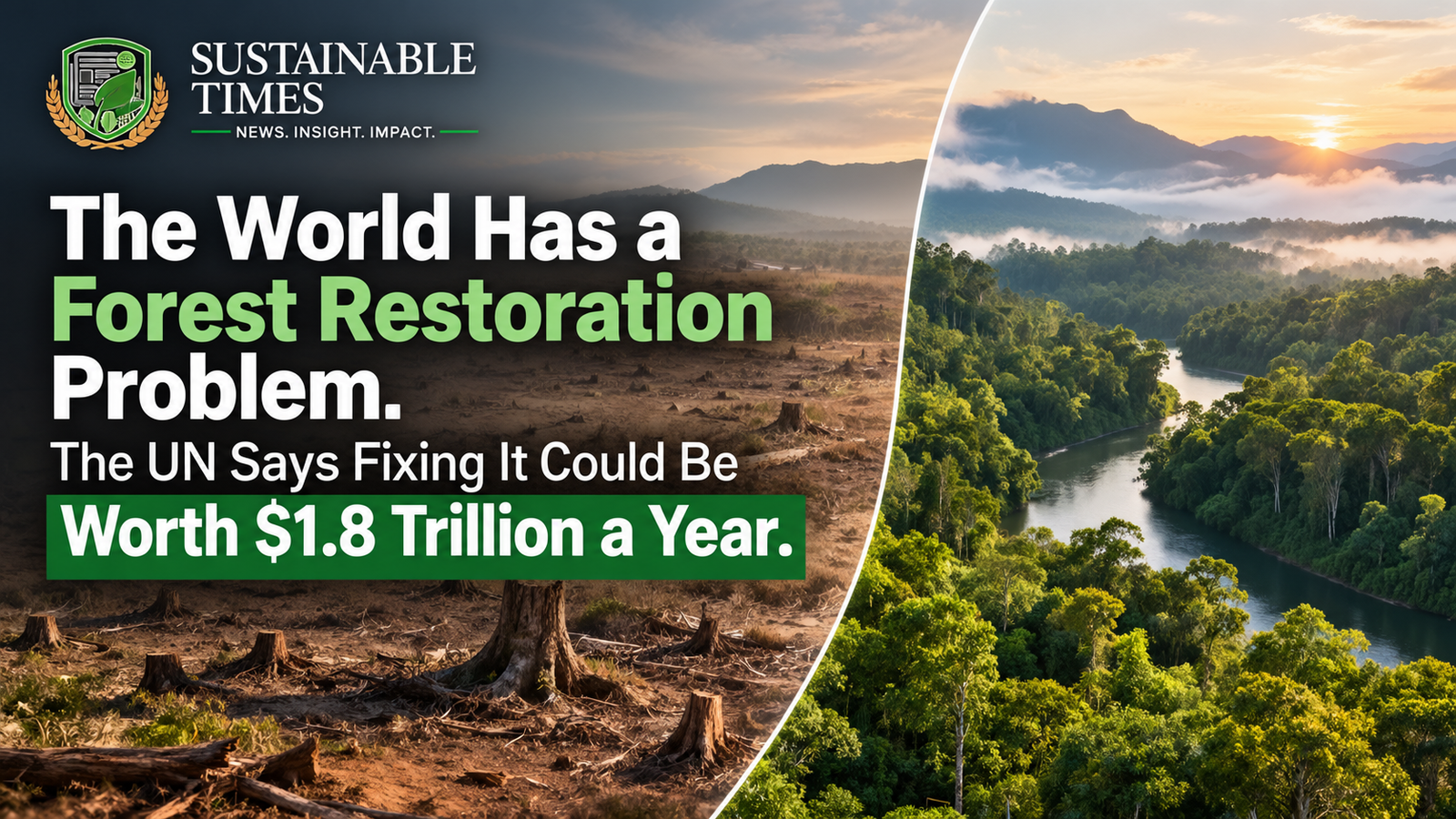
FAO estimates that restoring more than 1 billion hectares of degraded land could generate around $1.8 trillion in benefits every year, through healthier soils, improved water regulation, stronger biodiversity and other gains.
That changes the question.
Instead of asking whether forest restoration costs too much, perhaps the more important question is:
Can the world afford not to restore its damaged landscapes?
We have damaged an area larger than most countries can imagine
The world’s forests cover enormous areas, but the pressure on them has also reached an extraordinary scale.
FAO’s latest assessment puts total degraded land at 1.56 billion hectares.
That is roughly 53 times the land area of Italy, according to FAO’s interactive 2026 forest assessment.
Forest degradation does not always look like a clear-cut landscape.
A forest can remain standing while losing biodiversity, soil quality, ecological functions or its ability to withstand drought, fire and disease.
That distinction matters because simply measuring whether trees remain standing can hide how much ecological capacity a landscape has already lost.
Restoration therefore goes beyond planting seedlings.
It can mean recovering native vegetation, repairing soils, restoring waterways, improving agricultural landscapes and allowing natural ecosystems to recover.
In some places, planting trees will be appropriate.
In others, protecting natural regeneration may work better.
The right solution depends on the landscape.
The world has already promised to restore more than one billion hectares
There is no shortage of international ambition.
Over the past two decades, governments and international initiatives have pledged to place more than one billion hectares under restoration.
The problem is implementation.
FAO says the world still needs to bring at least 470 million hectares under restoration by 2030 to meet global restoration goals.
That is a huge gap to close in only a few years.
And restoration cannot happen simply because governments announce targets.
It requires landowners, farmers, Indigenous communities, local governments, businesses, investors and scientists to work together.
It also requires something that environmental campaigns often struggle to secure:
long-term money.
Restoration is becoming an economic argument
The most interesting part of FAO’s new report may be its economic message.
The organisation estimates that failing to restore degraded ecosystems could cost the world between $878 billion and $6.3 trillion every year, depending on the scope of the impacts included in the calculation.
That makes land degradation more than an environmental problem.
It becomes a financial liability.
Damaged landscapes can reduce agricultural productivity.
They can worsen water insecurity.
They can increase vulnerability to floods, droughts and extreme weather.
They can undermine biodiversity.
They can reduce rural incomes.
And they can force communities and governments to spend more money dealing with the consequences.
Restoration reverses part of that equation.
Healthier landscapes can produce food, protect water, support livelihoods and provide ecosystem services at the same time.
A restored forest can also be a food-security project
The connection between forests and food is often underestimated.
FAO says nearly one-third of the world’s population depends on forests and trees for food security and livelihoods.
That dependence takes many forms.
People collect food from forests.
Communities depend on forest products for income.
Trees protect soils.
Forests influence rainfall and water cycles.
Agroforestry systems can combine trees with crops and livestock.
Healthy landscapes can also make farms more resilient when droughts, heatwaves or heavy rainfall disrupt conventional production.
This is why the new FAO report deliberately places forest restoration within a wider landscape rather than treating forests as isolated patches of green.
A forest does not exist separately from the farm next to it.
A river does not stop being part of the landscape when it crosses an agricultural boundary.
And soil degradation does not respect administrative borders.
Restoration works best when the entire landscape enters the conversation.
Farmers could become central to the restoration economy
One of the most important implications of this approach concerns agriculture.
Farmers manage enormous areas of land.
That makes them essential to any serious attempt to restore degraded landscapes.
But restoration cannot simply mean asking farmers to sacrifice productive land.
If restoration is going to scale, it has to make economic sense for the people managing the land.
That could mean agroforestry.
It could mean restoring riparian vegetation along waterways.
It could mean improving soil organic matter.
It could mean integrating trees into grazing systems.
It could mean restoring degraded pasture.
It could mean protecting natural regeneration instead of clearing and replanting.
The appropriate approach will vary from one region to another.
The bigger principle is straightforward.
Land restoration and agricultural production should not automatically be treated as competing objectives.
In many landscapes, they can support each other.
Nature does not always need us to plant a tree
The global enthusiasm for tree planting has created an unfortunate misconception.
Restoration does not always begin with a nursery.
Sometimes nature already knows what to do.
If a degraded landscape still contains healthy seed sources, restoring grazing patterns, controlling invasive species, protecting young vegetation and reducing disturbance can allow forests to regenerate naturally.
That can be cheaper and, in some circumstances, more ecologically appropriate than planting large numbers of trees.
FAO’s approach reflects this broader understanding of restoration.
The objective is not simply to increase the number of trees.
It is to restore the function of the landscape.
That difference could become increasingly important as countries race to meet restoration commitments.
A landscape filled with poorly chosen trees is not necessarily a healthy ecosystem.
A naturally regenerating forest can be far more valuable.
Fire is making the restoration challenge harder
The world’s forests face another growing pressure: fire.
FAO estimates that around 127 million hectares of forest are affected by fires every year. Insects, diseases and increasingly severe weather events add further pressure.
That creates a difficult cycle.
Climate change can increase heat and drought.
Drier landscapes can become more vulnerable to severe fires.
Fires can damage forests and soils.
Degraded landscapes can then become harder to restore.
The solution cannot simply be to plant more trees after every major fire.
Countries need better landscape planning, fire management, ecological restoration and community involvement.
That is one reason FAO’s current World Forest Week discussions are focusing on resilience as well as restoration.
Restoration could create a new rural economy
There is another side of the story that deserves more attention.
Restoration requires people.
Someone has to collect seeds.
Someone has to raise seedlings where planting makes sense.
Someone has to prepare degraded land.
Someone has to monitor whether ecosystems are recovering.
Someone has to manage fire risk.
Someone has to restore watersheds.
Someone has to help farmers change land-management practices.
That creates economic activity.
FAO says restoration can generate jobs, revitalise production systems and support more resilient rural economies.
This matters particularly in regions where rural communities face pressure from declining agricultural productivity, land degradation or limited employment opportunities.
A restoration economy does not have to mean paying communities simply to plant trees.
It can create long-term work around land management, agriculture, ecological monitoring, forest products and local enterprises.
Indigenous and local communities cannot be an afterthought
Forest restoration projects can fail when outsiders decide what a landscape should look like without understanding the people who already live there.
Local communities often possess detailed knowledge about soils, water, native species, fire behaviour and seasonal changes.
Indigenous Peoples in particular hold knowledge systems developed over generations of interaction with forests and landscapes.
FAO’s 2026 report highlights the importance of inclusive governance as countries scale restoration.
That is not simply a social consideration.
It can determine whether restoration survives after a project ends.
A landscape can be planted in one season.
A functioning ecosystem may take decades.
Long-term stewardship therefore matters as much as initial investment.
The world is still far from delivering on its restoration promises
Governments have made significant commitments.
According to FAO, 91 countries and areas have pledged more than 190 million hectares for forest restoration.
That represents meaningful progress.
But pledges are not restored ecosystems.
The gap between announcement and implementation remains one of the biggest challenges facing global restoration.
Countries need better monitoring.
They need reliable financing.
They need clear land rights.
They need local participation.
They need to measure whether restoration actually improves biodiversity, soil health, water systems and livelihoods.
Otherwise, a restoration target can become another impressive number without much ecological change behind it.
Technology can help answer a difficult question: Is restoration actually working?
Restoration is becoming increasingly measurable.
Satellite imagery can track changes in vegetation.
Remote sensing can identify land degradation.
Geospatial platforms can map restoration projects.
Drones can monitor difficult terrain.
Field surveys can measure biodiversity and soil conditions.
FAO is also highlighting digital and innovative forest monitoring as countries try to improve how they track restoration progress.
This matters because investors and governments increasingly want evidence.
If billions of dollars flow into restoration, they need to know whether the money produces measurable results.
That could eventually make restoration more accountable.
It could also help identify which approaches work best in different landscapes.
The biggest mistake would be treating restoration as a climate-only solution
Planting and protecting forests can remove carbon from the atmosphere.
That makes restoration relevant to climate policy.
But carbon should not become the only reason to restore an ecosystem.
A forest is not merely a carbon storage facility.
It is habitat.
It protects soils.
It influences water.
It supports livelihoods.
It can provide food.
It can support cultural traditions.
It can reduce erosion.
It can help landscapes cope with extreme weather.
If restoration programmes measure only tonnes of carbon, they can overlook many of the benefits that make ecosystems valuable in the first place.
FAO’s new report deliberately links restoration to climate, biodiversity, food security, land degradation and human wellbeing.
That broader approach is important.
There is a financial argument hiding in the forest
FAO’s estimate of $1.8 trillion in annual benefits from restoring more than one billion hectares deserves attention.
It suggests that restoration is not simply an expense.
It can generate economic value.
The benefits can appear through healthier agricultural land, improved water regulation, biodiversity, rural employment and greater resilience.
FAO also reports that restoration can generate returns of up to $30 for every $1 invested under favourable conditions.
The phrase “under favourable conditions” is important.
Restoration economics vary enormously between regions and projects.
Not every restoration project will produce the same return.
But the broader message remains powerful.
Degraded land is not necessarily dead capital.
With the right approach, it can become productive ecological and economic infrastructure again.
What happens if the world waits?
The temptation is to treat forest restoration as something that can happen later.
Climate change is urgent.
Biodiversity loss is urgent.
But restoring landscapes takes time.
Trees grow slowly.
Soils recover slowly.
Watersheds respond slowly.
Ecological relationships can take decades to rebuild.
That creates a dangerous mismatch between the speed of environmental damage and the speed of ecological recovery.
FAO warns that the cost of inaction is already enormous.
Waiting does not preserve today’s problem.
It can make tomorrow’s restoration more expensive.
A degraded landscape can continue losing soil.
A damaged watershed can become more difficult to repair.
A fragmented habitat can lose species that restoration cannot easily bring back.
The cheapest time to prevent some forms of degradation is often before restoration becomes necessary.
Restoration is becoming a test of whether sustainability can move beyond promises
The world has no shortage of sustainability commitments.
Countries promise forest restoration.
Companies announce nature strategies.
Financial institutions discuss nature-related risk.
Governments set biodiversity targets.
Consumers demand more responsible products.
The harder part is turning those commitments into changes on the ground.
That is where the next decade will matter.
A billion hectares is not restored through speeches.
It requires millions of decisions made by farmers, communities, businesses, governments and investors.
It requires better science.
Better financing.
Better monitoring.
And, perhaps most importantly, a willingness to treat ecosystems as productive infrastructure rather than empty land waiting for another economic use.
The forest story is really a food story, a water story and an economic story
That may be the most important message from FAO’s latest assessment.
Forests are usually discussed as if they belong to environmental policy.
But forests influence agriculture.
Agriculture influences food prices.
Water connects forests to farms and cities.
Biodiversity supports ecosystems and production.
Healthy landscapes support rural economies.
Climate resilience depends partly on functioning natural systems.
Once these connections become visible, forest restoration stops looking like a niche environmental project.
It starts looking like infrastructure investment.
Only this infrastructure does not consist of concrete and steel.
It consists of healthy soil, functioning forests, clean water, biodiversity and landscapes capable of supporting people.
The opportunity is enormous, but the clock is moving
The world has already lost hundreds of millions of hectares of forest through deforestation since 1990.
Another 1.56 billion hectares of land now sits in some form of degradation.
Yet FAO’s new assessment also shows that the damage does not have to define the future.
More than a billion hectares could potentially be restored.
The economic value could reach trillions of dollars each year.
Food systems could become more resilient.
Biodiversity could recover.
Water systems could strengthen.
Rural communities could gain new economic opportunities.
Climate resilience could improve.
The challenge is scale.
The world knows many of the restoration techniques it needs.
What it has not yet demonstrated is whether it can deploy them quickly enough, across landscapes large enough, while giving local people a meaningful role in deciding what restoration should look like.
That is the real test.
The next great forest story may not be about how many trees the world plants.
It may be about whether humanity can turn damaged land back into functioning landscapes before the opportunity becomes much more expensive.
About The Author