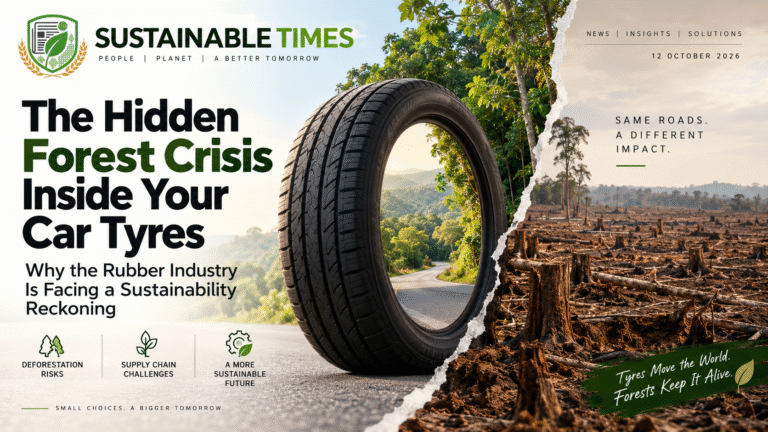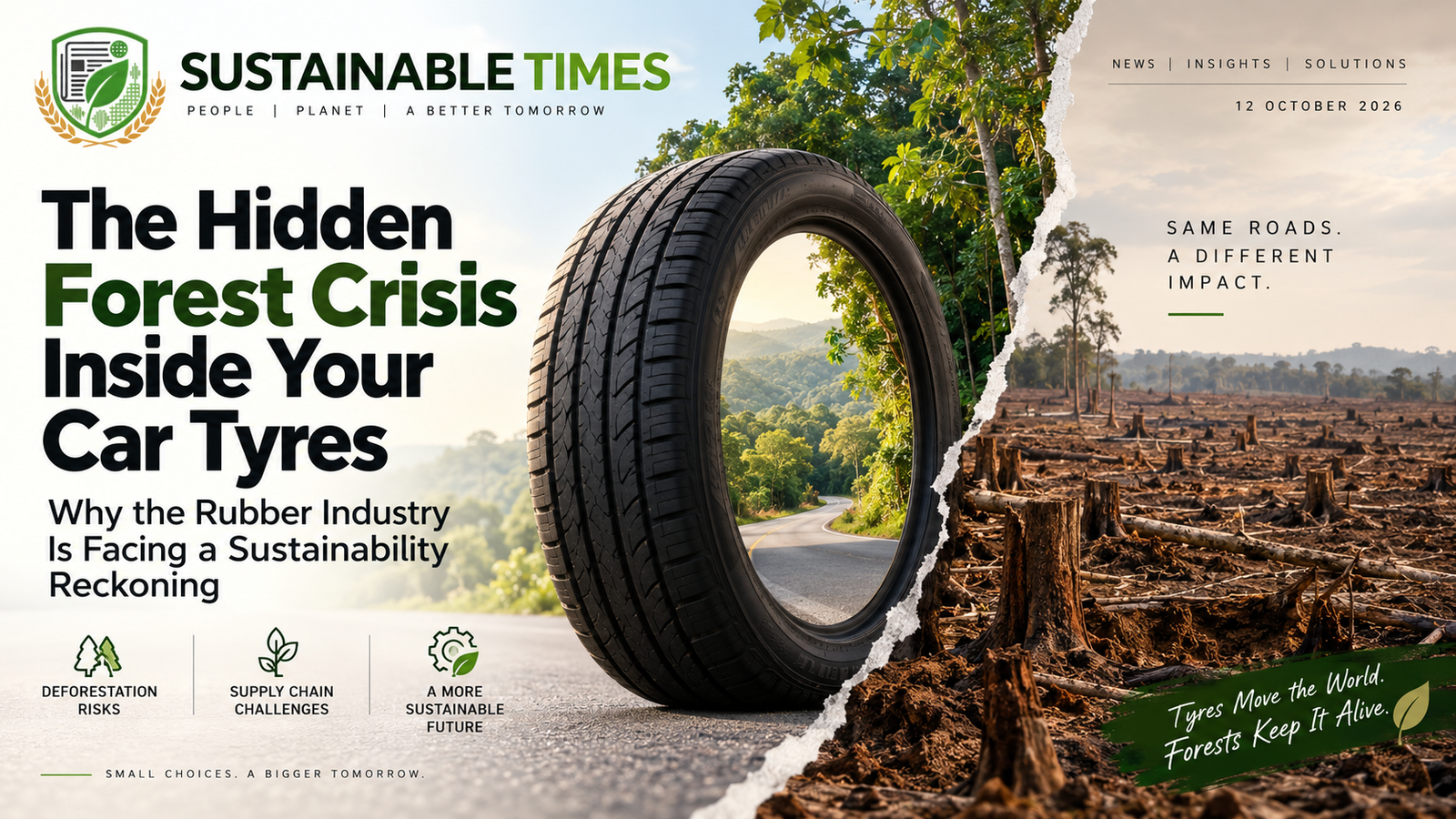
Every time a car moves, its tyres depend on a material that begins its journey thousands of kilometres away, often on a small tropical farm.
Natural rubber gives tyres many of the properties needed to withstand constant friction, pressure and changing road conditions. Yet the journey from rubber tree to finished tyre has created an environmental problem that the automotive industry can no longer afford to overlook.
A recent Reuters investigation, published on 8 October 2026, highlights how the global tyre industry is struggling to address deforestation, biodiversity loss and poor traceability in natural rubber supply chains.
Research has linked natural rubber cultivation to approximately four million hectares of tropical deforestation since 1993, an area roughly the size of Switzerland. Much of the industry’s rubber originates from Southeast Asia, where millions of small farmers supply an intricate network of traders, processors and manufacturers.
The problem is becoming more urgent as Europe prepares to enforce tougher rules against products connected to deforestation.
For companies such as Michelin, Continental, Pirelli and Bridgestone, the challenge is no longer simply producing safer and more efficient tyres. It is proving that the rubber inside them did not come at the expense of tropical forests.
A Supply Chain That Begins Far From the Factory
Natural rubber comes primarily from the Hevea brasiliensis tree, which produces a milky liquid called latex.
Farmers collect the latex, which then passes through collectors, traders and processing facilities before reaching tyre manufacturers.
Unlike industries dominated by large plantations, natural rubber relies heavily on small-scale agriculture.
Approximately 85% of global natural rubber production comes from smallholder farmers, many of whom cultivate plots averaging only two or three hectares.
This creates an enormous traceability challenge.
A single tyre may contain rubber originating from thousands of farms. The material can change hands several times before a manufacturer receives it, making it difficult to identify the precise land where the rubber was produced.
That matters because companies cannot credibly guarantee deforestation-free sourcing without understanding where their raw materials come from.
The challenge becomes even more complicated when smallholders lack formal land documentation, digital records or the financial resources needed to meet new environmental requirements.
The Deforestation Problem Few Consumers Notice
Palm oil, beef and timber have faced public scrutiny for their connections to deforestation for years.
Natural rubber has received considerably less attention.
One reason is visibility.
Consumers can find palm oil in food and cosmetic products, making it easier for environmental organisations to connect everyday purchases with tropical forests.
Natural rubber is different.
It sits inside tyres, industrial equipment, footwear and countless manufactured goods. Its origins remain largely invisible to consumers.
Yet satellite-based research has revealed that rubber cultivation has contributed substantially to tropical forest loss.
As demand for tyres and other rubber products has expanded, producers have faced incentives to convert additional land into plantations.
That process can fragment habitats, reduce biodiversity and place pressure on ecosystems.
The environmental consequences do not disappear simply because rubber comes from a tree.
A renewable raw material is not automatically a sustainably produced material.
Europe Is About to Make Traceability Much More Important
The European Union’s Deforestation Regulation, commonly known as the EUDR, is adding pressure to the industry.
The regulation covers several commodities associated with deforestation, including natural rubber and certain products derived from it.
Under the rules, relevant businesses must demonstrate that covered products meet deforestation-related and legal-production requirements before placing them on the EU market or exporting them.
The European Commission has confirmed that the regulation is scheduled to begin applying at the end of December 2026, following legislative changes designed to simplify implementation.
For tyre manufacturers, this creates a practical challenge.
They need reliable information about the farms supplying their rubber, even when that material passes through multiple intermediaries.
For smallholders, the situation is more complicated.
Farmers who cannot provide the necessary information may find themselves excluded from supply chains serving European customers, even when they have not personally cleared forests.
That makes the EUDR both an environmental opportunity and a potential economic risk for vulnerable producers.
Michelin Is Trying to Map the Journey From Tree to Tyre
Some manufacturers have spent years preparing for tighter traceability requirements.
Michelin has developed a digital platform called RubberWay, designed to collect information about farming practices, social conditions and environmental risks within natural rubber supply chains.
Reuters reports that RubberWay has gathered information from more than 280,000 smallholders, helping the company assess risks across its sourcing network.
Michelin has also introduced farm-level geolocation efforts and satellite-based deforestation-risk assessments.
These tools help companies connect raw-material purchasing with the locations where rubber originates.
But digital mapping alone does not guarantee sustainability.
Reliable systems also require accurate data, farmer participation, clear purchasing standards and action when problems emerge.
And past environmental controversies remain relevant.
Environmental organisations have questioned aspects of Michelin’s historical rubber investments in Indonesia, while the company disputes allegations that it misrepresented the conditions surrounding those projects.
The disagreement illustrates why transparency must extend beyond current sourcing practices to the wider environmental history of production landscapes.
Continental Is Taking a Different Approach
While Michelin has emphasised large-scale traceability, Continental has invested in closer relationships with rubber farmers.
Working with German development agency GIZ, the company supports a project in Indonesia’s Kapuas Hulu district that trains smallholders in more sustainable agricultural practices.
The initiative began with approximately 400 farmers in 2018 and has expanded to around 4,000 participants.
Continental also supports more direct sourcing relationships and pays premiums for sustainably produced rubber.
The approach addresses a problem that technology cannot solve by itself.
Farmers need a financial reason to adopt better practices.
If a sustainable farming method requires additional labour, recordkeeping or investment but produces no meaningful income benefit, participation may remain limited.
Direct relationships can help manufacturers understand those economic pressures and provide support where it matters.
The challenge is scale.
Four thousand farmers represent meaningful progress within one programme, but the global natural rubber industry depends on millions of producers.
Expanding such initiatives without losing their effectiveness will be difficult.
Could Growing Other Crops Between Rubber Trees Help?
One of the more promising approaches involves agroforestry.
Instead of cultivating rubber trees alone, farmers can grow complementary crops between them.
These may include coffee, cocoa and other plants that provide additional income while the rubber trees mature.
Bridgestone has supported farmer-training programmes involving such practices in parts of Asia and West Africa.
The potential benefits go beyond income diversification.
Well-designed agroforestry systems can improve soil management, support habitat diversity and reduce the economic pressure farmers face when rubber prices decline.
But agroforestry is not a universal solution.
Some systems produce lower yields, while certain companion crops can attract animals that damage young rubber trees.
Farmers must balance environmental benefits with productivity, labour requirements and market demand.
The strongest projects will therefore adapt to local landscapes rather than applying the same farming model everywhere.
The Industry Is Even Looking at Dandelions
Perhaps the most unusual development comes from research into alternative rubber sources.
Continental has investigated producing natural rubber from the roots of the Russian dandelion, Taraxacum kok-saghyz.
Unlike tropical rubber trees, this plant can grow in temperate regions.
That could eventually allow manufacturers to source some natural rubber closer to their factories, potentially reducing dependence on tropical plantations and long-distance transport.
Continental began researching dandelion rubber more than a decade ago and demonstrated a truck tyre using the material in 2016.
However, large-scale commercial production remains a challenge. Dandelion cultivation currently faces limitations involving yield, labour and production economics.
The technology is therefore better viewed as a potential diversification strategy than a near-term replacement for conventional rubber plantations.
Still, the research points toward an interesting possibility: the future of sustainable tyres may depend partly on changing where rubber can be grown.
The Biggest Challenge Is Not Technology. It Is Farmer Income.
Traceability platforms, satellite monitoring and alternative rubber sources all have a role to play.
But the economics of smallholder farming may ultimately determine whether the industry succeeds.
Rubber prices can fluctuate sharply, leaving farmers with little financial certainty. When earnings fall, producers may struggle to replace ageing trees or invest in better agricultural practices.
Some may shift toward other crops that promise stronger returns.
That creates a difficult situation for manufacturers.
They want more sustainable rubber, but the farmers supplying it often lack the resources needed to meet higher standards.
The Global Platform for Sustainable Natural Rubber (GPSNR) is attempting to close part of that gap through collaboration between manufacturers, producers and environmental organisations.
Its Shared Investment Mechanism raised approximately $3 million in 2025, supporting projects that reached around 60,000 smallholders across five countries.
These programmes provide training and help farmers improve production practices.
However, the number of participating farmers remains small compared with the millions who depend on natural rubber cultivation worldwide.
If the industry wants deforestation-free sourcing to become standard practice, it will need investment that reaches far beyond a handful of demonstration projects.
Electric Vehicles Will Not Make This Problem Disappear
The transition toward electric vehicles is changing the automotive industry, but it does not eliminate the need for tyres.
Electric cars still depend on durable rubber products, making responsible sourcing relevant to the future of sustainable mobility.
This exposes an important weakness in how the automotive industry’s environmental progress is sometimes discussed.
A vehicle may produce no exhaust emissions during driving while still depending on materials associated with deforestation, resource extraction or other environmental impacts.
That does not undermine the benefits of vehicle electrification.
It demonstrates why the transition to cleaner transport requires attention to manufacturing and raw materials alongside operating emissions.
The next generation of automotive sustainability strategies will therefore need to look beyond batteries and electricity.
They must also examine steel, aluminium, plastics, rubber and the wider supply chains that support vehicle production.
Sustainability Is Becoming a Supply-Chain Test
The rubber industry’s environmental challenge is increasingly becoming a commercial challenge.
Manufacturers face regulatory pressure, evolving customer expectations and risks associated with unstable agricultural production.
Meanwhile, climate change itself is affecting the landscapes where rubber grows.
Extreme heat, unpredictable rainfall, disease and prolonged drought can reduce latex yields and make farming more difficult.
That means protecting ecosystems is not separate from protecting the future supply of rubber.
It is becoming part of the same business problem.
Companies that invest in healthier landscapes, better farmer incomes and more transparent supply chains may strengthen their ability to source rubber over the long term.
Those that focus only on documentation risk missing the underlying reasons why unsustainable production continues.
The Next Step Must Go Beyond Proving Where Rubber Came From
The industry’s immediate priority is understandably traceability.
Companies want to identify the farms supplying their raw materials and demonstrate that production meets environmental requirements.
But knowing where rubber originated does not automatically repair ecosystems damaged in previous decades.
Environmental groups increasingly argue that manufacturers should also invest in restoring degraded landscapes and supporting communities affected by past land conversion.
That would move the industry beyond avoiding new environmental harm toward addressing some of the damage already associated with its supply chains.
Such efforts would require long-term financing and credible environmental monitoring.
They would also need to respect the livelihoods of the farmers whose land and labour sustain the industry.
Looking Ahead
The coming months could mark an important turning point for natural rubber.
Europe’s deforestation rules are raising expectations around traceability, while manufacturers are experimenting with digital mapping, direct farmer relationships, agroforestry and alternative materials.
Yet the industry’s biggest challenge remains remarkably human.
Millions of small farmers need to earn a reliable living from rubber without expanding production into valuable forests.
If manufacturers can help farmers improve productivity, maintain healthy landscapes and access markets that reward better practices, sustainability could become an economic opportunity rather than another compliance burden.
If they cannot, the industry risks creating a system where only the best-resourced producers can demonstrate compliance.
The future of sustainable tyres may therefore depend less on what happens inside a factory and more on what happens on a small rubber farm thousands of kilometres away.
The next time the automotive industry talks about greener mobility, the conversation should not end with electric motors and cleaner batteries. It should also include the forests, farmers and rubber trees that keep those vehicles moving.
About The Author