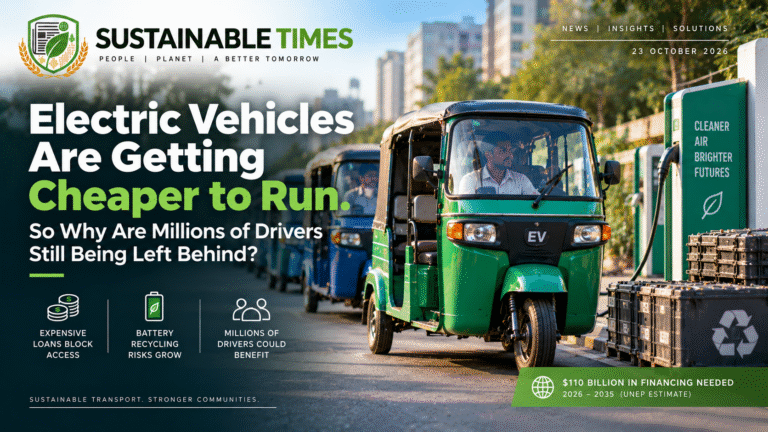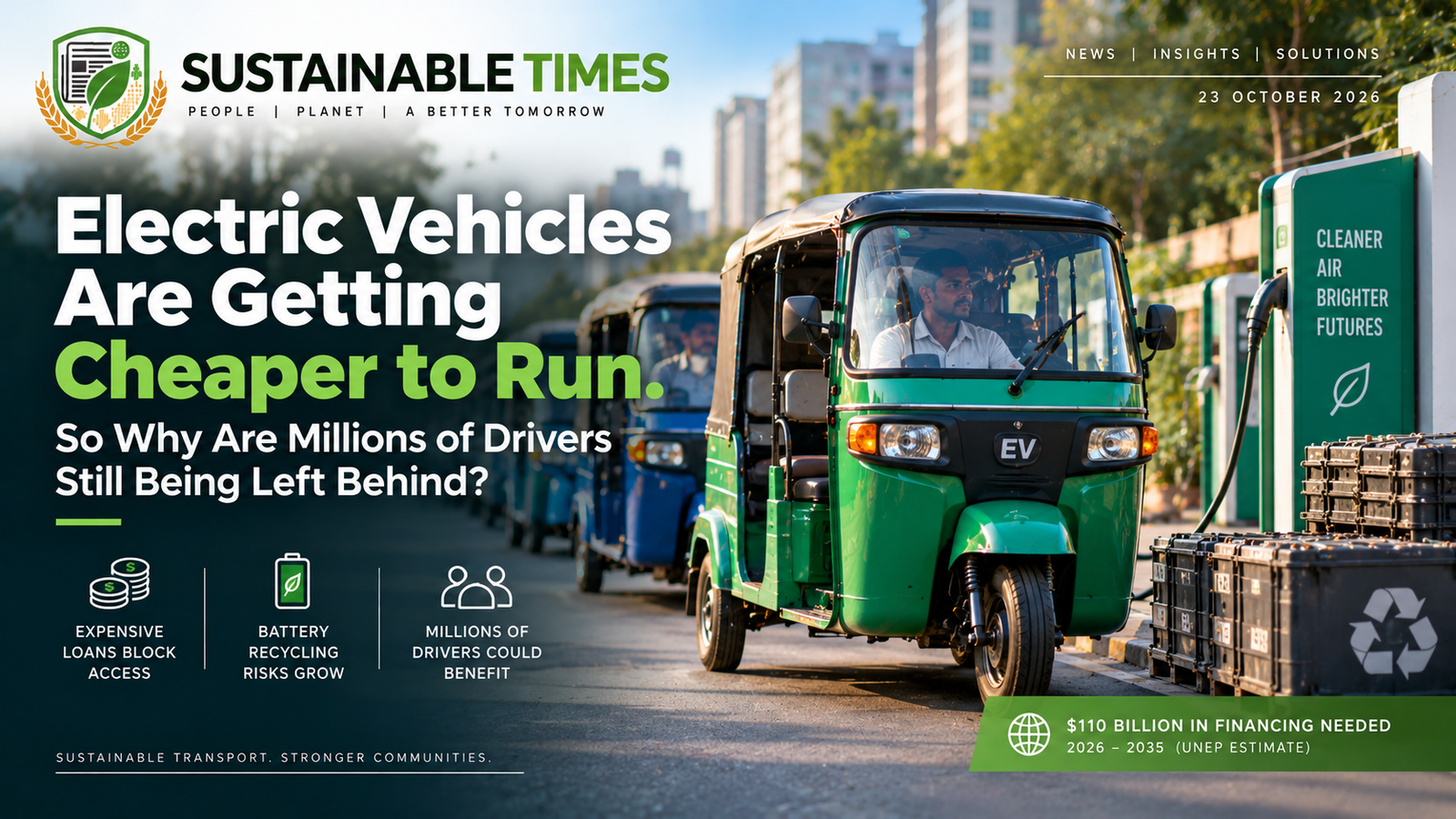
Electric vehicles have spent years fighting a familiar argument: they cost too much.
But across parts of the developing world, the economics are beginning to tell a different story. Electric motorcycles and three-wheelers can already offer lower running and maintenance costs than petrol-powered alternatives, particularly for drivers who travel long distances every day.
The problem is that many of those drivers still cannot afford to buy one.
A new update from the United Nations Environment Programme (UNEP), published on 22 October, highlights two challenges that could determine whether electric mobility succeeds across emerging economies: access to affordable finance and the safe management of millions of batteries when vehicles reach the end of their useful lives.
UNEP estimates that the transition to electric two- and three-wheelers across developing markets could require approximately $110 billion in financing between 2026 and 2035.
At the same time, a separate UN study warns that more than four million tonnes of used lithium-ion batteries could enter low- and middle-income countries, excluding China, inside imported electric cars by 2035.
Together, the findings expose an important reality.
The next stage of electric mobility will depend less on proving that electric vehicles work and more on building financial and recycling systems around them.
The Electric Mobility Revolution Is Already Happening
In many developing economies, motorcycles and three-wheelers are essential transportation rather than optional purchases.
They carry commuters through crowded cities, transport goods between markets and provide livelihoods for taxi drivers, delivery workers and small businesses.
Unlike private cars, these vehicles often operate throughout the day.
That makes fuel and maintenance costs particularly important.
Electric models can offer considerable savings because electric motors generally require less routine maintenance than internal combustion engines, while electricity can cost less than petrol for equivalent travel.
India provides one of the clearest examples of this shift.
According to UNEP, electric three-wheelers now account for almost 70% of new three-wheeler sales in India, overtaking compressed natural gas models.
That is an important milestone for a transport category used extensively for commercial and passenger mobility.
But India’s progress is not representative of every emerging market.
In parts of Africa and Latin America, high borrowing costs continue to place electric vehicles beyond the financial reach of the people who could benefit most from operating them.
The Biggest Barrier May Be the Loan, Not the Vehicle
Consider a motorcycle taxi driver in Nairobi.
An electric motorcycle may offer lower daily operating costs than a petrol model. However, buying it often requires financing.
That is where the calculation can become difficult.
UNEP reports that some commercial riders in African markets face annual borrowing rates ranging from 45% to 90%.
In China, comparable financing rates can be around 4% to 8%.
The difference is enormous.
A vehicle that saves money on fuel may still become unaffordable when the buyer must repay an expensive loan.
High borrowing costs can absorb the savings that make electric mobility attractive in the first place.
This creates an unusual situation.
The technology may already make economic sense over its useful life, but the financial system prevents potential customers from accessing those benefits.
UNEP’s new analysis therefore argues that affordable credit could become one of the most powerful tools for accelerating electric mobility.
A Different Way to Finance a Motorcycle
Traditional vehicle loans often rely on formal income records, credit histories and conventional collateral.
Those requirements can exclude drivers working in informal or semi-formal transport markets.
A motorcycle taxi operator may earn a reliable daily income without receiving a regular salary or maintaining the documentation that banks usually request.
UNEP identifies alternative financing arrangements that could help close this gap.
One option involves assessing borrowers according to the income their vehicles generate rather than relying exclusively on conventional salary records.
Another uses battery and vehicle data to help lenders understand how frequently an electric motorcycle operates and how its condition changes over time.
Guarantees and risk-sharing arrangements can also encourage financial institutions to lend to customers they would otherwise consider too risky.
Vehicle-as-a-service models offer another possibility by allowing operators to pay for vehicle access rather than purchasing the entire asset upfront.
These approaches already exist in different forms, but UNEP argues that scaling them could make electric mobility more accessible across developing economies.
The organisation estimates that suitable financing arrangements could improve commercial drivers’ net cash flow by as much as 30% in some markets.
That would make electrification an income opportunity rather than simply an environmental obligation.
The Second Problem Begins When the Battery Dies
Making electric vehicles affordable solves only part of the sustainability challenge.
The other problem appears years later.
What happens when their batteries can no longer power them effectively?
Lithium-ion batteries contain valuable materials, but damaged or improperly handled batteries can also create serious environmental and safety risks.
If countries lack appropriate collection and recycling systems, spent batteries may end up in informal workshops, uncontrolled dumpsites or poorly managed storage facilities.
Such conditions can expose workers and nearby communities to hazardous materials and fire risks.
UNEP’s new technical report on end-of-life electric-vehicle battery management warns that developing countries face a growing challenge as electric vehicles expand and used vehicles move across international markets.
By 2035, more than four million tonnes of spent lithium-ion batteries could arrive in low- and middle-income countries, excluding China, through imported electric cars.
The same vehicle-import flows are projected to contain lead-acid batteries holding approximately 842,000 tonnes of lead.
This is not simply a future waste-management issue.
It is a question of whether today’s clean-transport transition will create new pollution problems tomorrow.
Recycling Could Become a Major Green Industry
The battery challenge also presents an economic opportunity.
Modern recycling technologies can recover valuable metals and other materials from used batteries.
These recovered materials can potentially return to battery manufacturing and other industrial supply chains, reducing dependence on newly extracted resources.
However, the ability to recycle batteries efficiently depends on collection infrastructure, suitable processing facilities, technical expertise and clear safety standards.
UNEP is urging governments to establish stronger rules before large quantities of batteries reach the end of their useful lives.
Its recommendations include producer-responsibility systems, national battery tracking and stronger oversight of recycling operations.
These policies could help ensure that companies remain accountable for batteries after vehicles are sold.
They could also encourage investment in formal recycling businesses that provide safer employment and retain more economic value within local markets.
For countries developing domestic electric-vehicle industries, recycling could eventually become an important part of manufacturing strategy.
The Informal Recycling Economy Cannot Be Ignored
In many developing economies, informal workers already collect, repair and recover materials from discarded products.
Their activities can provide essential income and keep valuable materials out of conventional waste streams.
But battery dismantling without appropriate equipment, training and pollution controls can expose workers to significant hazards.
UNEP’s recommendations recognise that simply banning informal recycling would not solve the underlying problem.
Instead, governments need to help workers move into safer, regulated activities.
That could involve training, access to protective equipment, formal employment opportunities and stronger links between collectors and licensed recycling facilities.
The goal should be to improve environmental safety without removing livelihoods from communities that already depend on material recovery.
This makes battery recycling as much a social and economic challenge as a technological one.
Rwanda Is Testing What Happens After the First Battery Life
UNEP is also exploring ways to extend the usefulness of batteries before recycling becomes necessary.
In Rwanda, a new $1.7 million project supported by UNEP and the Global Environment Facility is examining potential second-life applications for retired batteries.
A battery that no longer meets the performance requirements of an electric vehicle may still retain enough capacity for certain stationary energy-storage applications.
For example, suitable retired batteries could potentially store electricity for buildings or small energy systems.
But second-life use requires careful testing.
Not every battery remains safe or economically practical to reuse. Battery condition, chemistry, performance and safety must all be assessed before redeployment.
The Rwanda project will help explore whether these applications can become practical in emerging markets.
If successful, such approaches could extend battery service life while creating additional value before final recycling.
India Has an Opportunity Beyond Selling More Electric Vehicles
India’s electric three-wheeler market demonstrates what can happen when vehicle technology, customer demand and business economics begin working together.
The country’s electric-mobility expansion is also creating opportunities across battery manufacturing, charging infrastructure, financing and recycling.
However, UNEP’s findings suggest that future success should not be measured solely by vehicle sales.
A sustainable electric-transport system also needs affordable access for drivers, reliable charging, safe batteries and systems that recover materials at the end of their useful lives.
That is particularly important as India’s delivery, logistics and shared-mobility sectors continue adopting electric vehicles.
Companies developing financing and battery-management models could play an increasingly important role alongside traditional vehicle manufacturers.
The opportunity extends beyond environmental performance.
Better financing may help drivers reduce operating costs, while formal recycling can create jobs and strengthen domestic supply chains.
The Real Opportunity Is Building the System Around the Vehicle
Electric mobility is often presented as a competition between petrol and electric vehicles.
But UNEP’s latest findings suggest that the transition is becoming a much broader infrastructure and finance challenge.
A vehicle can be efficient and affordable to operate but remain inaccessible without suitable credit.
A battery can help reduce tailpipe emissions during use but create environmental risks if nobody manages it responsibly after retirement.
A country can increase electric-vehicle sales without establishing the systems needed to support those vehicles over their entire life cycle.
That is why the two new UNEP studies belong in the same conversation.
They address different stages of the same transition.
One asks how more people can afford electric vehicles.
The other asks what happens when those vehicles become waste.
Together, they point toward a more complete definition of sustainable transport.
Looking Ahead
The electric-vehicle transition is entering a stage where financing, infrastructure and circular-economy policies could matter as much as improvements in vehicle technology.
For developing economies, this creates both an opportunity and a responsibility.
Affordable finance could help millions of drivers move away from petrol-powered vehicles and reduce their daily operating costs.
Safe battery collection and recycling could protect communities while creating valuable new industrial activity.
Countries that develop both systems may gain an advantage as electric mobility continues expanding.
Those that focus only on vehicle sales risk discovering the environmental costs later.
The lesson from UNEP’s latest research is straightforward.
The future of clean transport will not be decided only by how many electric vehicles reach the road. It will also depend on who can afford to drive them and what happens to their batteries when the journey ends.
About The Author