A garment factory can meet production targets, supply international fashion brands and produce thousands of pieces of clothing every day. But behind the sewing machines and production lines, workers may be struggling with an environmental problem that rarely appears on clothing labels.
Heat.
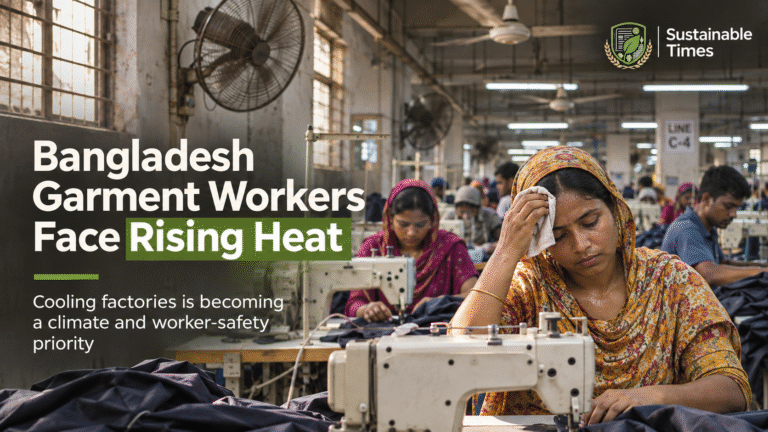
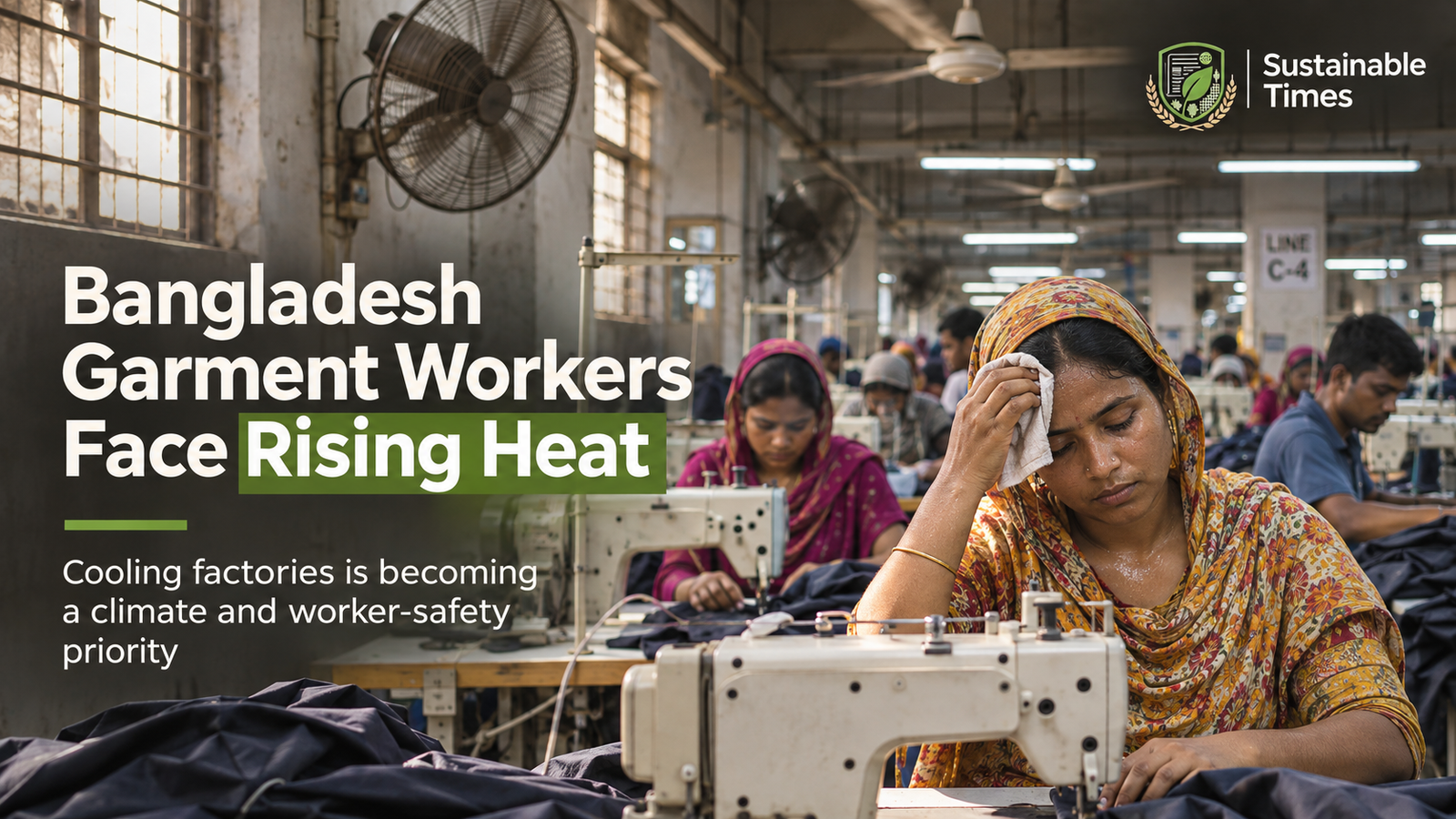
In Bangladesh, one of the world’s most important garment-manufacturing centres, rising temperatures are making factory floors increasingly difficult and potentially dangerous places to work.
New reporting published on 6 November highlights how extreme indoor heat is affecting garment workers’ health, productivity and livelihoods. It draws on research from Cornell University’s Global Labor Institute, which found that factories could recover the cost of cooling improvements within one to four years.
The findings challenge a familiar idea about sustainable fashion.
Reducing the environmental footprint of clothing is important. But protecting the people who manufacture it is becoming equally critical as climate change intensifies.
Inside a Factory Where the Heat Does Not Stop
For 20-year-old sewing operator Mridula, extreme heat is not simply another uncomfortable part of the working day.
According to reporting by Mongabay, she collapsed at her workplace in Dhaka after experiencing dizziness during intense heat.
Her experience reflects a wider challenge facing Bangladesh’s garment industry, which employs approximately 4.2 million people.
Factories often contain tightly arranged sewing machines, industrial lighting, ironing equipment and other heat-generating machinery.
When buildings have inadequate ventilation or insulation, indoor temperatures can climb well above comfortable working conditions.
Workers may spend long hours performing repetitive tasks that require concentration and precision.
Excessive heat can make those tasks harder while increasing the risk of dehydration, exhaustion and other health problems.
Medical staff working in garment facilities have reported dehydration, low blood pressure and increased workplace injuries during hotter periods.
However, researchers warn that the full scale of the problem remains difficult to measure because many factory medical systems focus on immediate emergencies rather than the longer-term effects of repeated heat exposure.
The Numbers Reveal a Growing Workplace Risk
Cornell University’s Global Labor Institute examined conditions in eight garment factories in the Dhaka region, alongside living conditions in approximately three dozen workers’ homes.
The researchers installed monitoring equipment to understand how heat and humidity affect workers throughout the day.
Their findings were concerning.
During 2025, Dhaka experienced a heat-stress season lasting approximately seven months.
Factory heat exposure frequently exceeded outdoor conditions, with cutting, ironing and finishing sections facing particularly serious risks.
A separate study of cooling strategies in a Dhaka garment factory found that peak indoor temperatures exceeded 35°C on 37% of monitored days.
The findings suggest that simply checking outdoor weather forecasts cannot provide an accurate picture of the conditions workers experience inside production facilities.
Buildings, machinery, ventilation and work practices can all influence exposure.
This makes factory-level monitoring essential for understanding the risks.
The Problem Does Not End When Workers Go Home
One of the most revealing parts of Cornell’s research concerns what happens after a factory shift ends.
Workers exposed to high temperatures during the day may return to homes that are also extremely hot.
That limits the time their bodies have to recover.
Researchers found that workers sometimes faced additional expenses for electricity, fans, healthcare and other necessities during the hottest months.
Some reported borrowing money, selling or pawning belongings, or reducing other household spending to cope with those costs.
This creates a cycle in which climate change affects both workplace safety and household finances.
A worker may experience heat stress at the factory, struggle to rest at home and return the following morning without adequate recovery.
That makes climate adaptation more complicated than installing cooling equipment at work.
It also raises questions about wages, housing conditions and access to healthcare.
Heat Is Becoming an Economic Problem for Fashion Brands
The research also reveals that rising temperatures can affect the financial performance of garment factories.
At one participating factory, researchers estimated that heat stress reduced annual revenue by approximately 4.1%.
The losses arose partly because excessive heat affected worker productivity.
When workers struggle with high temperatures, production can slow, mistakes may become more likely and workplace health risks can increase.
For manufacturers operating on narrow margins, even a modest decline in productivity can create substantial financial pressure.
The consequences can extend throughout the supply chain.
International fashion brands depend on factories meeting production schedules and delivering consistent product quality.
If rising temperatures affect manufacturing capacity, climate change becomes a business-continuity problem rather than only a workplace health issue.
That creates a strong economic reason for companies to invest in safer working conditions.
The Surprising Finding: Cooling Could Pay for Itself
The Cornell research challenges the assumption that improving factory cooling must impose a permanent financial burden.
Researchers assessed practical interventions including roof insulation, reflective roof coatings, improved ventilation and mechanical cooling.
They found that suitable investments could recover their costs within one to four years through improved productivity and other economic benefits.
A separate industry-level estimate suggested that approximately $239 million could support measures to reduce heat stress across Bangladesh’s garment sector.
That would represent roughly 0.2% of the country’s 2025 garment export revenues.
These figures do not guarantee that every factory will achieve the same result.
Cooling requirements, building conditions, electricity prices and production systems vary between facilities.
Still, the findings suggest that protecting workers from extreme heat can make financial sense.
Instead of treating workplace cooling as an unavoidable expense, manufacturers may increasingly view it as an investment in productivity, safety and long-term resilience.
Who Should Pay for Safer Factories?
The question becomes more difficult when researchers examine how the fashion supply chain operates.
Many garment manufacturers supply international brands under contracts that place significant pressure on production costs and delivery schedules.
Factories may recognise the need for better cooling but struggle to finance improvements while maintaining competitive prices.
Cornell’s researchers argue that fashion brands should share responsibility for climate adaptation.
That could involve purchasing arrangements that allow suppliers to invest in safer facilities, longer-term sourcing commitments or financial support for workplace improvements.
The idea is not that international brands should manage every aspect of factory operations.
Rather, the companies benefiting from global production networks have a role in ensuring that commercial pressures do not undermine worker safety.
This is becoming an increasingly important question for ESG strategies and responsible sourcing.
A brand may use recycled fibres and renewable electricity, but those achievements do not address the full sustainability challenge if the people producing its clothing face dangerous working conditions.
Bangladesh Needs Stronger Heat Protection Standards
Bangladesh already has legal requirements relating to workplace conditions.
However, researchers and labour advocates argue that heat-specific protections remain inadequate.
The country’s national heat-related illness guidance has focused heavily on outdoor work, while indoor industrial environments present different challenges.
Factory heat exposure depends on both environmental conditions and the equipment operating inside buildings.
Labour groups and researchers are now calling for clearer temperature-monitoring requirements, stronger workplace protections and better enforcement.
At discussions held in Dhaka in late October, industry representatives, researchers and workers’ organisations urged policymakers to develop a dedicated heat-stress framework for garment manufacturing.
The challenge will be creating standards that protect workers while helping factories adopt practical and affordable cooling measures.
Sustainable Fashion Needs a Wider Definition
The global fashion industry has spent years discussing its environmental footprint.
Brands have introduced recycled materials, emissions targets, more efficient production technologies and programmes to reduce waste.
These efforts remain important.
But the Bangladesh findings reveal another dimension of sustainability that companies cannot afford to overlook.
Climate change is already affecting the workers who keep global supply chains operating.
A truly sustainable fashion strategy must therefore consider both sides of the climate problem.
Companies need to reduce the emissions associated with manufacturing clothing.
At the same time, they need to help factories adapt to the higher temperatures that workers are experiencing today.
Those responsibilities are connected.
Reducing emissions addresses the long-term drivers of climate change.
Improving workplace conditions protects people from risks that already exist.
The Future of Fashion May Depend on Cooler Factories
The findings from Bangladesh offer a warning to garment-producing countries across Asia and beyond.
As temperatures rise, manufacturers may face growing risks involving worker health, productivity and operational reliability.
Yet the research also provides a practical reason for optimism.
Some of the solutions already exist.
Better insulation can reduce heat entering buildings. Improved ventilation can help remove hot air, while suitable cooling systems can make production areas safer.
The challenge is ensuring that factories can afford and maintain those improvements.
Governments, manufacturers, international buyers and workers’ organisations will need to cooperate if the industry is to respond effectively.
For fashion brands, the question is becoming increasingly difficult to ignore.
It is no longer enough to ask whether clothing was manufactured with lower emissions or more responsible materials.
Companies must also ask whether the people who made those products could work safely.
The next major sustainability improvement in fashion may not appear on a clothing label. It may be felt by a factory worker who can finally finish a shift without facing dangerous heat.
About The Author