A small bottle of omega-3 supplements sitting on a pharmacy shelf may appear to have little connection with Antarctica.
The same is true of a bag of premium pet food or a container of feed used at a fish farm.
Yet some of these products depend on an ingredient harvested from one of the most remote and environmentally sensitive regions on Earth.
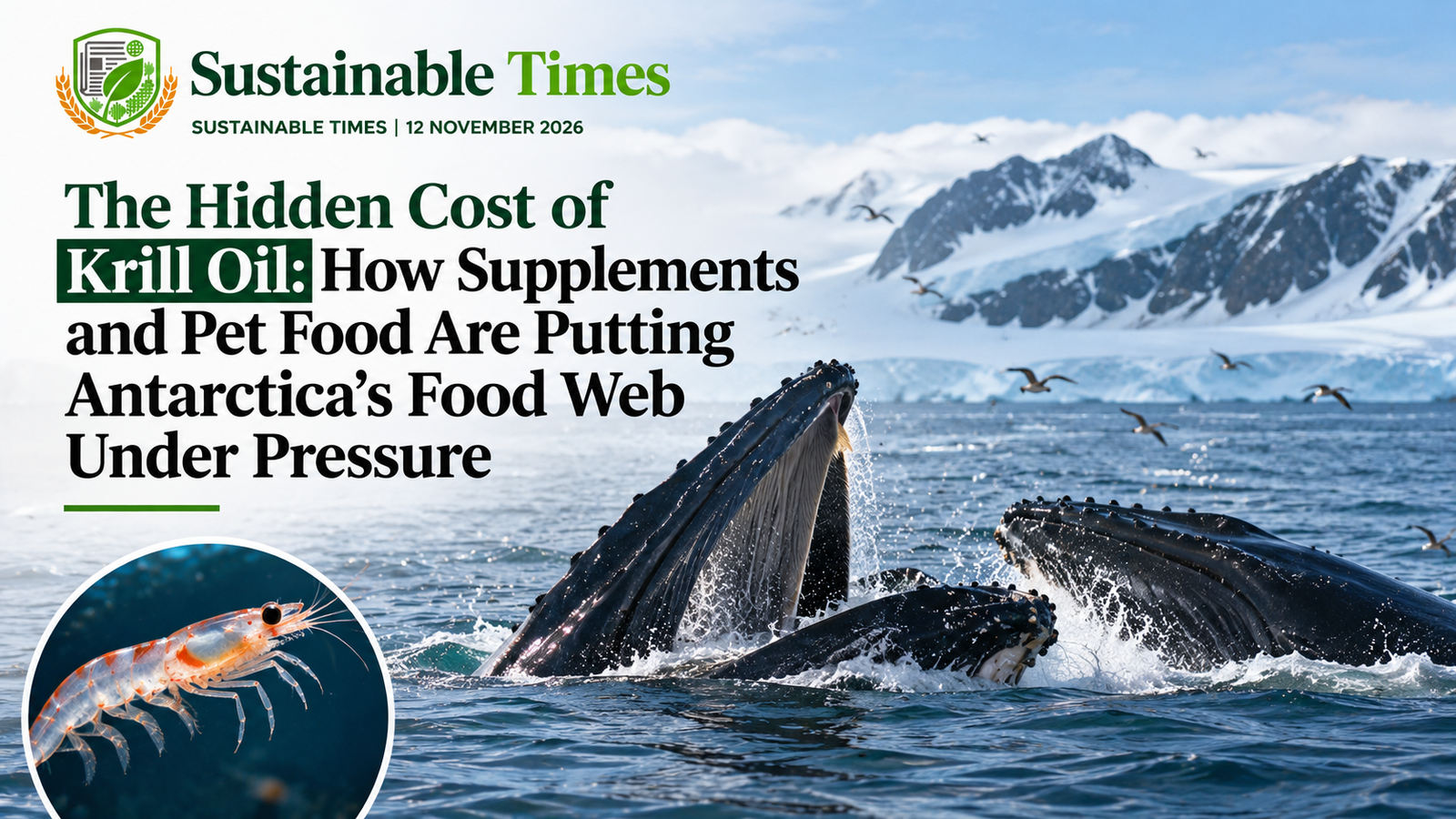
Antarctic krill.
These tiny, shrimp-like crustaceans form the foundation of the Southern Ocean’s food web. Whales consume enormous quantities of them, while penguins, seals, fish and seabirds also depend on krill for survival.
Now, growing commercial demand is raising difficult questions about how much krill humans should remove from Antarctic waters.
A Reuters investigation published on 11 November 2026 highlights the expanding krill-fishing industry and the failure of international negotiations to establish stronger marine protections.
The fishery reached its 620,000-tonne precautionary catch limit months ahead of schedule in both 2025 and 2026, intensifying concerns about fishing activity in areas where wildlife gathers to feed.
The dispute reveals an uncomfortable sustainability dilemma.
An ingredient marketed for human and animal health may be adding pressure to an ecosystem that supports some of the planet’s most extraordinary wildlife.
Why Such a Small Animal Matters So Much
Antarctic krill, scientifically known as Euphausia superba, rarely receives the attention given to whales or penguins.
But the survival of many larger Antarctic animals depends on it.
Krill feed primarily on microscopic marine organisms, including phytoplankton, and transfer that energy through the food web.
Baleen whales consume krill by filtering enormous quantities of seawater. Penguins and seals hunt them in the surrounding ocean, while fish and seabirds depend on the same food source.
Krill also contribute to the Southern Ocean’s carbon cycle.
As they feed and produce sinking waste particles, they help transport organic material into deeper waters.
This process forms part of the biological carbon pump, through which marine organisms move carbon away from surface waters.
Scientists are still investigating the scale of krill’s contribution to long-term carbon storage, but their ecological importance is already well established.
Removing krill from the ocean therefore affects more than a single commercial species.
It raises questions about the availability of food for animals throughout the Antarctic ecosystem.
How Krill Became a Valuable Commercial Ingredient
Krill fishing has developed into a specialised international industry.
Companies harvest Antarctic krill and process it into several products, including meal for aquaculture feed, ingredients for pet food and oil used in dietary supplements.
Krill oil is particularly attractive to the supplement industry because it contains omega-3 fatty acids.
Manufacturers market these products to consumers interested in nutrition and wellness.
Aquaculture businesses also use krill-derived ingredients in selected feeds for farmed fish and other aquatic animals.
These markets have helped create commercial demand for a resource that most consumers never encounter in its original form.
The connection between the finished product and its environmental origins can be difficult to recognise.
A consumer buying a supplement may understand the nutritional claims printed on the packaging without knowing where the krill was harvested.
Similarly, someone purchasing pet food may have little reason to investigate whether its ingredients came from Antarctic fisheries.
That distance between production and consumption is one reason the industry is attracting renewed environmental scrutiny.
The Fishing Limit Was Reached Months Early
The Commission for the Conservation of Antarctic Marine Living Resources, known as CCAMLR, regulates commercial fishing in Antarctic waters.
Its management system includes a precautionary catch threshold of approximately 620,000 tonnes for the main krill-fishing area in the southwest Atlantic sector of the Southern Ocean.
The threshold represents roughly 1% of the estimated krill biomass in that designated region.
That makes it relatively conservative compared with many conventional fisheries.
However, commercial fishing activity has expanded significantly.
In 2009, catches were approximately 126,000 tonnes.
By 2025, fishing vessels had reached the 620,000-tonne threshold, triggering an early closure.
The same happened in 2026.
Fishing stopped in August after vessels reached the annual limit, several months before the normal end of the season.
These closures demonstrate that the existing catch limit is being enforced.
But they also reveal how quickly the industry can now harvest the permitted quantity.
For conservation scientists, the concern is not simply the total amount of krill removed.
It is also where and when fishing occurs.
The Problem With Fishing in the Wrong Place
Krill are not distributed evenly throughout the Southern Ocean.
They gather in dense concentrations that attract both commercial fishing vessels and wildlife.
For whales and penguins, these concentrations provide essential feeding opportunities.
For fishing companies, they offer economically efficient harvesting locations.
That overlap creates potential competition.
A fishing operation may remain within the overall catch limit while removing substantial quantities of krill from a relatively small area.
The local effects could become particularly important near penguin breeding colonies or whale feeding grounds.
Until 2024, CCAMLR operated an additional management measure designed to distribute fishing activity across different sub-areas.
That arrangement lapsed when members failed to agree on its renewal.
Since then, conservation organisations have warned that fishing can become more concentrated in ecologically sensitive locations.
This is why researchers increasingly argue that managing krill requires more than setting a single overall catch limit.
Authorities also need to consider the location of fishing operations and the seasonal needs of Antarctic wildlife.
Climate Change Is Making the Situation More Complicated
Commercial fishing is not the only pressure affecting Antarctic krill.
Climate change is altering conditions across the Southern Ocean.
Rising ocean temperatures and changes in sea-ice coverage can affect krill habitat, reproduction and food availability.
Sea ice plays an important role in the krill life cycle, particularly for young animals that depend on the conditions associated with seasonal ice.
As Antarctic environments change, krill populations may shift their distribution.
That could alter where whales, penguins and other predators find food.
It also makes fisheries management more difficult.
A catch limit based on broad estimates of krill abundance may not fully capture the consequences of environmental changes in particular regions.
Scientists therefore want management systems that can respond to changing ecological conditions rather than relying exclusively on fixed historical assumptions.
The challenge is to understand the combined effects of fishing pressure, climate change and wildlife food requirements.
International Negotiations Have Reached Another Deadlock
Antarctic marine conservation depends heavily on international cooperation.
CCAMLR brings together countries with different interests, including those involved in fishing, scientific research and environmental protection.
Its decisions generally require consensus.
That arrangement encourages cooperation, but it can also make progress difficult when members disagree.
At the commission’s October 2026 meeting in Hobart, Australia, negotiators again failed to reach agreement on major new marine protected areas and stronger krill-management measures.
Proposals under discussion could expand protection across significant portions of the Southern Ocean.
However, disagreements over fishing access, conservation boundaries and management rules prevented a final agreement.
China and Russia have repeatedly opposed or blocked several proposed marine protected areas, while other countries and conservation organisations continue advocating stronger restrictions.
China has also advanced alternative proposals that would allow certain fishing activities within proposed protection frameworks.
The dispute illustrates how conservation goals can collide with national economic interests.
Countries broadly recognise the ecological importance of Antarctica, but they disagree about how much commercial activity should remain permissible.
The Sustainability Certification Debate
The controversy has also reached the seafood certification industry.
On 6 November, the Marine Stewardship Council announced that The QRILL Company’s Antarctic krill fishery was set to be recertified under its sustainability standard following an independent reassessment.
The decision came after environmental organisations, including WWF-UK and the Antarctic and Southern Ocean Coalition, challenged the initial certification recommendation.
An independent review concluded that certification could proceed, but additional conditions were needed.
Those conditions focus partly on improving localised management and reducing the risk that concentrated fishing could affect wildlife feeding grounds.
The Marine Stewardship Council argues that Antarctic krill fisheries operate under precautionary rules, including strict catch limits and scientific monitoring.
Industry representatives also point to measures designed to reduce bycatch and protect sensitive wildlife areas.
Conservation organisations, however, question whether current arrangements adequately address concentrated fishing and changing environmental conditions.
The disagreement does not mean all certified krill fishing is automatically unsustainable.
It shows why sustainability certification must account for more than the overall health of a harvested population.
The wider ecosystem matters too.
Retailers Are Beginning to Respond
The debate is moving beyond fisheries regulators and scientific organisations.
Environmental campaigners are urging retailers to reconsider selling krill oil supplements.
Some major retailers have already committed to avoiding or phasing out krill-derived products.
Their decisions reflect growing concern about the environmental consequences of harvesting a species so central to Antarctic wildlife.
For businesses, this creates a supply-chain question.
A product can be legally sourced and marketed as beneficial while still raising concerns about its wider ecological footprint.
Retailers may therefore face pressure to investigate the origin of ingredients, the conditions under which they are harvested and the strength of environmental safeguards.
The krill controversy also demonstrates how consumer expectations can influence industries operating thousands of kilometres away.
A purchasing decision in a supermarket or pharmacy can connect indirectly to commercial activity in Antarctic waters.
Can the Industry Become More Sustainable?
Fishing companies argue that responsible krill harvesting remains possible.
They point to scientific monitoring, catch limits, specialised fishing equipment and voluntary restrictions around sensitive wildlife habitats.
Some industry representatives have also proposed more advanced monitoring systems that could support changes to future catch allowances.
Conservation organisations remain cautious.
They argue that increasing catch limits before stronger spatial protections are established could intensify competition between fishing vessels and wildlife.
Both sides recognise the need for scientific information, but they disagree about how precautionary management should operate.
The most credible path forward would require reliable population monitoring, stronger safeguards around important feeding areas and rules that can adapt to changing environmental conditions.
Such measures would help determine whether commercial harvesting can coexist with the long-term needs of Antarctic ecosystems.
The Bigger Problem Is Hidden Inside Global Supply Chains
The krill debate reflects a wider challenge in sustainable business.
Consumers increasingly expect products to be environmentally responsible, but the ecological consequences of raw materials are not always visible.
A finished product may pass through processors, manufacturers, distributors and retailers before reaching a customer.
By that point, its connection to the original ecosystem may be almost impossible to recognise without detailed traceability.
This problem affects many industries, from seafood and agriculture to cosmetics and nutritional supplements.
Companies cannot evaluate sustainability only by examining the final product.
They must also understand where ingredients originate and how extraction or production affects surrounding ecosystems.
For krill-derived products, that means considering the role of krill in Antarctic food webs rather than focusing exclusively on the sustainability of commercial catch volumes.
What Happens Next?
The latest negotiations have left Antarctic conservation at a difficult crossroads.
Commercial krill fishing continues under existing rules, while proposals for stronger marine protection remain unresolved.
The early closure of the fishery in two consecutive years demonstrates that harvesting capacity has grown substantially.
At the same time, changing sea-ice conditions and other climate pressures are creating additional uncertainty.
Future progress will depend on whether CCAMLR members can agree on stronger spatial management, improved monitoring and protections that reflect the needs of wildlife.
Certification organisations will also face pressure to demonstrate that their standards account for ecosystem-level risks.
Meanwhile, retailers and consumers may increasingly question whether krill-derived ingredients are necessary in products that could use alternative sources.
The central issue is not whether Antarctic krill has commercial value.
It clearly does.
The question is whether that value can be realised without weakening the ecological relationships that make the Southern Ocean so important.
The Smallest Animals May Hold the Biggest Conservation Lesson
Antarctica often captures public attention through images of enormous whales, penguin colonies and vast expanses of ice.
But much of that extraordinary wildlife depends on an animal small enough to fit in the palm of a hand.
Krill supports the food web that allows larger species to survive.
It also participates in ecological processes that connect the ocean’s surface with deeper waters.
As commercial demand grows, protecting this small crustacean is becoming an increasingly important test of international marine conservation.
The challenge extends beyond fishing quotas or product certification.
It asks whether businesses and governments can recognise the value of leaving enough of a natural resource in the ecosystem where it performs an essential role.
The future of Antarctic wildlife may depend not only on protecting whales and penguins, but also on protecting the tiny creatures that feed them.
About The Author