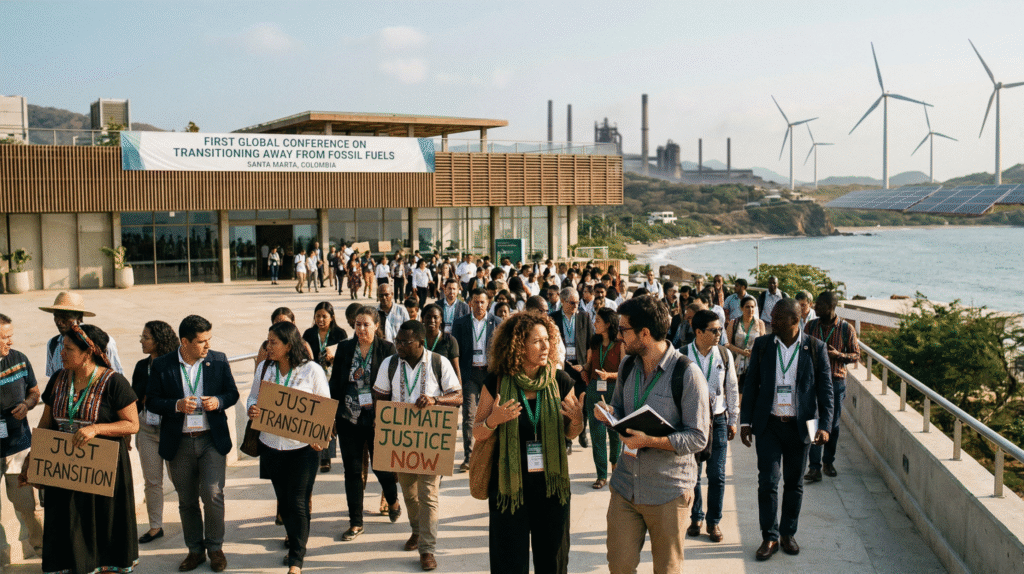
Santa Marta will host a major global conference on transitioning away from fossil fuels from 24 to 29 April 2026. The event will bring together governments, cities, experts, and civil society groups. Overall, participants will explore practical ways to speed up the shift to clean energy.
Action-Focused Approach to Climate Transition
Colombia and Netherlands are co-hosting the conference. Notably, organizers have designed it as an action platform instead of a negotiation forum.
The event will focus on real solutions. In addition, it will help countries reduce fossil fuel dependence while protecting jobs and communities. At the same time, economic stability will remain a key priority.
Leaders also want to build a strong coalition. Therefore, this group will push faster climate action at a global level. Meanwhile, the outcomes will support discussions linked to COP30 and COP31.
Key Themes and Discussions
The conference will focus on three main areas:
- Reducing economic reliance on fossil fuels
- Transforming energy supply and demand
- Strengthening global cooperation
Importantly, these themes go beyond emissions. They also address jobs, finance, governance, and policy alignment.
Experts will discuss how to reduce fossil fuel extraction. In particular, they will examine how to remove subsidies that support fossil fuels.
On the demand side, discussions will cover clean energy adoption and energy access. Additionally, participants will address risks linked to new fossil fuel infrastructure. As a result, countries can avoid long-term emission lock-ins.
Strong International Participation
As of 30 March 2026, 45 countries had confirmed participation. Furthermore, more than 2,600 organizations have shown interest.
Several UN agencies will join the event. For example, these include the United Nations Environment Programme, the Office of the United Nations High Commissioner for Human Rights, and the International Labour Organization.
The event will run in two phases. First, stakeholder discussions will take place from 24 to 27 April. Then, a high-level segment will follow on 28 and 29 April. Ministers and senior leaders will attend this phase.
However, organizers will manage participation based on venue capacity and compliance checks.
Why This Conference Matters
Global climate action still lags behind scientific warnings. Therefore, this conference aims to close that gap.
It will turn climate commitments into practical steps. In this way, countries can adapt solutions to their own needs.
At the same time, the event highlights a broader shift. Policymakers now link climate action with human rights, labor protection, and economic transition.
Ultimately, the conference could shape future global strategies. It may also influence how countries reduce fossil fuel use in a fair and realistic way.
About The Author