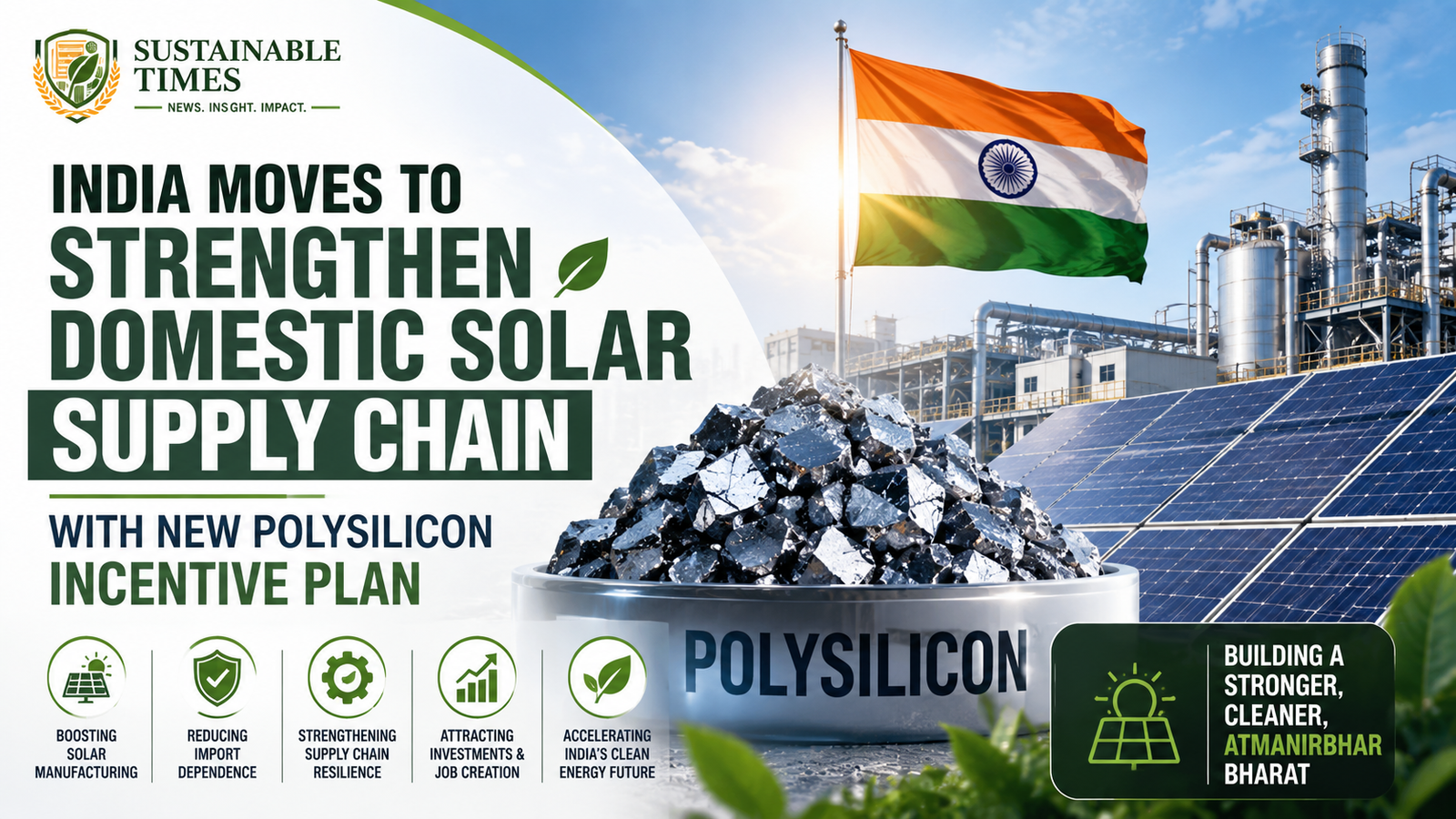
India plans to introduce a production-linked incentive (PLI) scheme for domestic polysilicon manufacturing, marking a significant step toward strengthening the country’s solar supply chain and reducing its dependence on imports from China.
The move comes as countries increasingly treat clean-energy manufacturing as both a sustainability priority and a strategic economic issue. Polysilicon forms a critical part of the conventional solar photovoltaic supply chain, making access to the material important for expanding domestic solar manufacturing.
India Targets Greater Solar Manufacturing Independence
India currently relies heavily on imported polysilicon, while China dominates global production. The proposed incentive scheme aims to encourage companies to manufacture the material domestically and build a more resilient solar manufacturing ecosystem.
The government sees domestic production as a way to reduce supply-chain exposure while supporting India’s broader renewable-energy expansion.
This strategy could also create opportunities for investment across several stages of the solar value chain, from raw materials and wafers to solar cells and modules.
Why Polysilicon Matters
Polysilicon sits near the beginning of the conventional crystalline-silicon solar supply chain.
Manufacturers use it to produce silicon ingots and wafers, which then become key components in solar cells and photovoltaic modules.
That makes the availability and cost of polysilicon important for the wider solar industry. A stronger domestic supply could help Indian manufacturers manage international supply disruptions and improve their control over production costs.
Clean Energy Meets Energy Security
India’s latest move reflects a broader global trend.
Governments increasingly connect renewable-energy expansion with energy security, industrial policy, and supply-chain resilience. The United States, for example, announced a 15% tariff on imported polysilicon derivatives this week and introduced price floors for certain solar-related products to encourage domestic manufacturing.
These developments show how the clean-energy transition increasingly extends beyond installing renewable capacity. Countries now want to build the industrial infrastructure that supports renewable energy as well.
The Sustainability Opportunity
Domestic solar manufacturing can create several potential benefits:
- Stronger supply-chain resilience
- Greater domestic manufacturing capacity
- New investment and employment opportunities
- Reduced exposure to international supply disruptions
- Support for long-term renewable-energy deployment
- Greater strategic control over clean-energy technologies
However, expanding manufacturing capacity alone does not automatically guarantee a lower environmental footprint. Policymakers and manufacturers will also need to address the energy intensity, resource use, emissions, and waste associated with polysilicon production.
A Global Shift in Clean-Tech Manufacturing
India’s announcement comes at a time when countries around the world are competing to build domestic clean-technology industries.
The solar industry illustrates this shift particularly clearly. Governments increasingly want to combine renewable-energy deployment with domestic manufacturing, technology development, and supply-chain security.
At the same time, the industry is also seeing greater attention to responsible sourcing and traceability. In July, the Solar Stewardship Initiative announced that a polysilicon manufacturing site in China had become the first polysilicon site to receive certification against its ESG and supply-chain traceability standards.
Looking Ahead
India’s proposed polysilicon incentive scheme could become an important piece of its long-term solar manufacturing strategy.
If implemented effectively, the programme could help India build a more integrated domestic solar supply chain while supporting its renewable-energy ambitions.
The bigger story, however, goes beyond India. As governments compete to secure critical clean-energy materials and manufacturing capacity, the next phase of the energy transition will depend not only on how quickly countries deploy renewable energy, but also on how sustainably and securely they build the supply chains behind it.
Key Takeaway
India’s planned polysilicon incentive scheme shows how renewable energy, industrial policy, and energy security are becoming increasingly interconnected. The global clean-energy race is moving upstream—from deploying solar panels to securing the materials and manufacturing capabilities needed to produce them.
About The Author