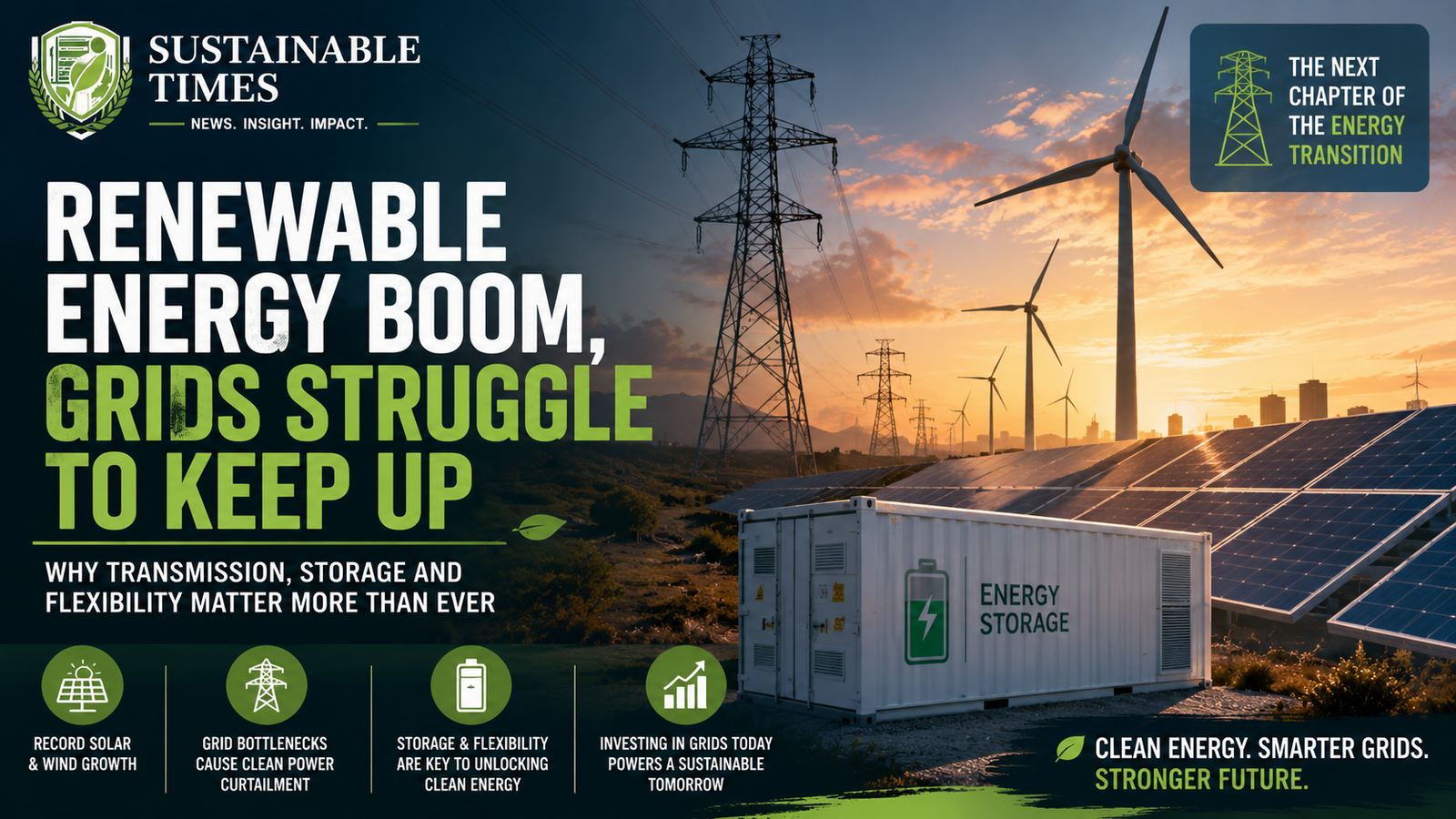
The world is building renewable energy faster than it can build the infrastructure needed to use all of it.
That problem is becoming increasingly visible in China, the world’s largest renewable energy market. A new Reuters analysis reports that China curtailed an estimated 360 terawatt-hours of clean electricity between January and June 2026 because parts of its power grid could not absorb or transmit all the available generation.
In simple terms, some wind and solar electricity was produced—or could have been produced—but the grid could not use it.
The issue points to a challenge that is becoming harder to ignore: adding renewable capacity is only half of the energy transition. The other half is building a power system capable of moving, storing and balancing that electricity.
China Shows the Scale of the Problem
China continues to add renewable capacity at extraordinary speed.
By the end of June, the country had installed around 1.27 terawatts of solar capacity and 680 gigawatts of wind capacity, according to China’s National Energy Administration. Solar capacity had grown 15.8% year on year, while wind capacity increased 18.5%.
That rapid expansion is helping transform China’s electricity system, but it is also placing new pressure on transmission networks.
Much of China’s renewable generation is concentrated in resource-rich regions, while major electricity demand centers are located farther east and south. Moving large amounts of electricity across those distances requires substantial transmission capacity and a grid that can respond quickly to changing supply.
This Is Not Just a China Problem
The same challenge is appearing in other renewable-heavy markets.
When solar and wind production rises sharply while electricity demand remains relatively low, grid operators may have to reduce renewable output to maintain system stability. This process is known as curtailment.
The International Energy Agency has identified grid congestion and limited flexibility as growing obstacles to renewable integration. Its latest electricity outlook says more than 2,500 GW of renewable, storage and large-load projects are currently stalled in grid connection queues worldwide.
That figure includes projects that are waiting for grid access rather than being rejected because the technology itself does not work.
The message is becoming clearer: the clean-energy transition is increasingly a grid infrastructure challenge.
Batteries Can Help, But They Are Not the Whole Answer
Energy storage is one of the most important tools available.
Large-scale batteries can store surplus solar or wind power and release it when demand rises. They can also provide rapid grid-balancing services, helping operators manage sudden changes in electricity supply and demand.
But storage alone cannot solve every transmission problem.
Countries also need new transmission lines, stronger distribution networks, smarter grid controls and electricity markets that reward flexibility. Technologies such as dynamic line rating and advanced power-flow controls can also help operators make better use of existing infrastructure.
The IEA estimates that grid-enhancing technologies and regulatory changes could unlock significant additional capacity before major transmission projects are completed.
The Sustainability Question
Renewable-energy curtailment creates an uncomfortable contradiction.
A country can install enormous amounts of solar and wind capacity and still fail to use a meaningful portion of the electricity if the surrounding power system cannot accommodate it.
That does not make renewable energy ineffective. Instead, it shows that generation, transmission, storage and demand need to grow together.
The next stage of the energy transition will therefore require more than record-breaking installation numbers. It will require better coordination between power producers, grid operators, regulators, storage developers and large electricity consumers.
A New Opportunity for Clean Technology
The grid bottleneck is also creating a growing market for innovation.
Battery storage, flexible demand, smart grids, digital power management and grid-enhancing technologies could become as important to the energy transition as solar panels and wind turbines themselves.
Large electricity users—including data centers, industrial facilities and electric-vehicle charging networks—could also play a role by shifting some of their electricity consumption to periods when renewable power is abundant.
That approach turns electricity demand from a problem into part of the solution.
Looking Ahead
The renewable-energy race is entering a different phase.
For years, the central question was how quickly countries could build solar panels, wind farms and other clean-energy projects. Increasingly, the question is whether power grids can keep pace.
China’s experience offers an early warning for other markets: building clean generation without sufficient transmission, storage and flexibility can leave valuable renewable electricity unused.
The next major investment cycle may therefore be less about producing more clean power and more about making sure the clean power already being produced can reach the people and industries that need it.
Key Takeaway
The global renewable-energy transition is moving from a generation challenge to a systems challenge. Solar and wind capacity are growing rapidly, but without stronger grids, storage and flexible electricity demand, countries risk leaving more clean energy on the sidelines.
About The Author