The United States is heading toward another major year for clean-energy development, even as the country’s energy policy remains politically complicated.
New data and industry forecasts point to strong growth in solar power, battery storage and other clean-energy infrastructure in 2026. At the same time, rising electricity demand—particularly from data centers and new industrial activity—is creating a powerful new reason to build more generation capacity.
The development highlights an important change in the energy transition. Renewable energy is no longer growing only because governments want to cut emissions. In many parts of the U.S., businesses increasingly need more electricity, and clean energy offers one of the fastest ways to supply that demand.
Solar and Storage Lead the Expansion
The U.S. Energy Information Administration (EIA) expects developers to add 86 gigawatts (GW) of new utility-scale electricity capacity in 2026 if all currently planned projects come online.
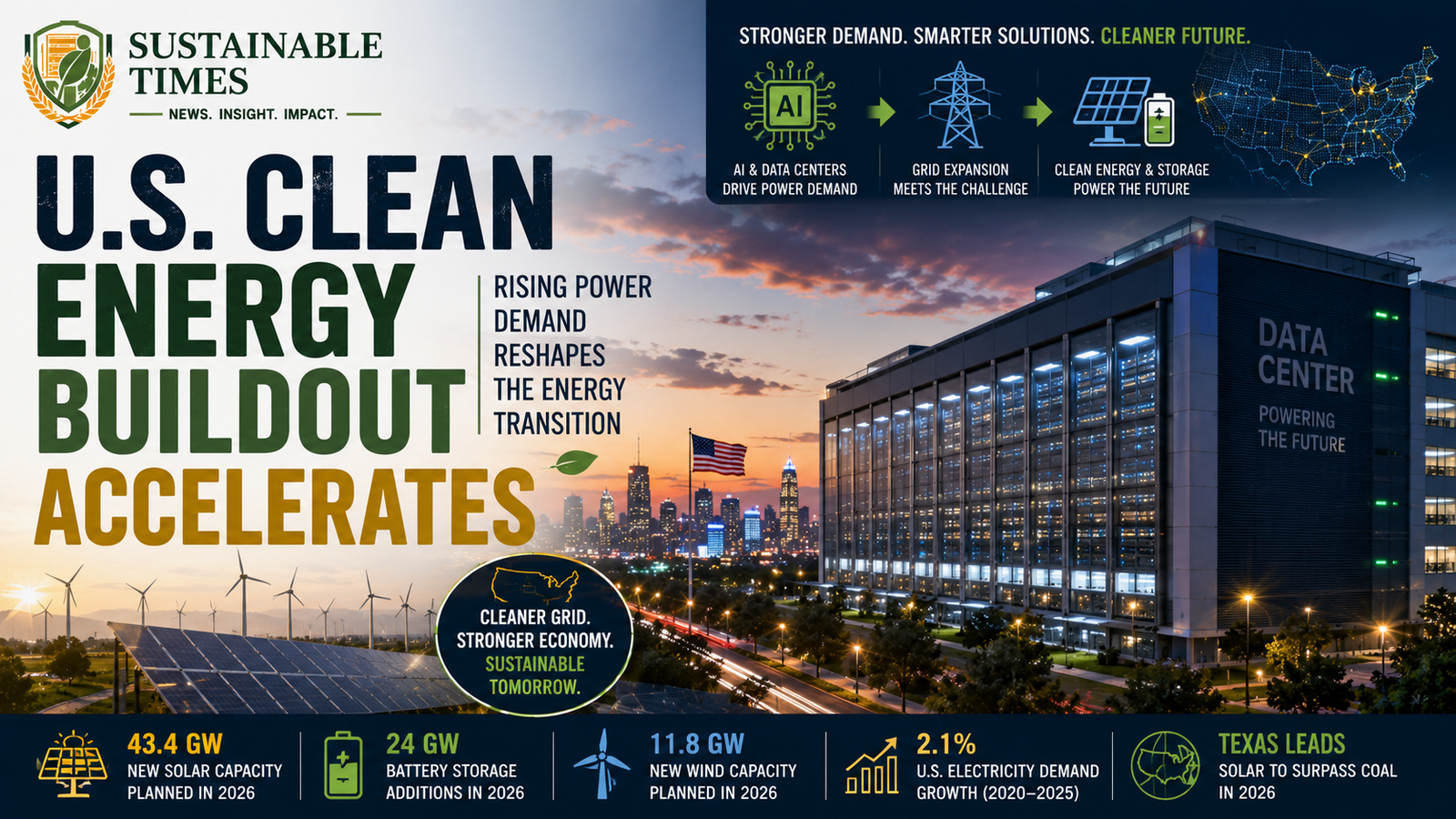
Solar accounts for about 43.4 GW, or roughly half of the planned additions. Battery storage follows with around 24 GW, while developers plan approximately 11.8 GW of new wind capacity.
The numbers show how closely solar and storage are becoming linked.
Solar produces its strongest output during daylight hours, while batteries can store some of that electricity and release it later when demand increases. That combination can help grids manage growing electricity consumption without relying entirely on conventional generation.
AI Is Changing Electricity Demand
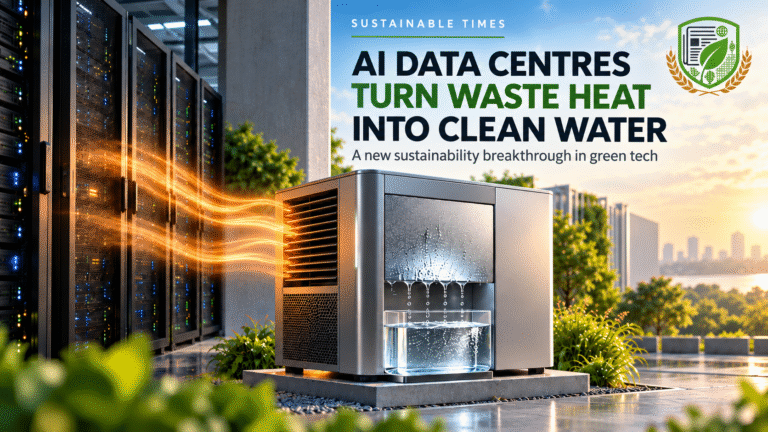
The rapid expansion of data centers has become one of the biggest new drivers of U.S. electricity demand.
The EIA says U.S. electricity consumption increased by an average of 2.1% per year between 2020 and 2025, after more than a decade of relatively little growth. It expects electricity demand to continue increasing through 2050, with data-center electricity use playing a major role.
The International Energy Agency estimates that U.S. electricity demand will add more than 420 terawatt-hours between 2025 and 2030, with data centers accounting for around half of that growth.
That creates a new challenge for the energy sector: the grid needs to expand quickly while also becoming cleaner.
Texas Is Becoming a Key Test Market
Texas sits at the center of this transition.
The state has become one of the largest markets for both renewable-energy development and new electricity demand. EIA expects around 40% of U.S. utility-scale solar additions in 2026 to occur in Texas.
The agency also expects solar generation in the Texas grid region, ERCOT, to exceed coal generation on an annual basis for the first time in 2026. Battery storage is expanding alongside solar, helping the grid manage changes in renewable generation.
This combination could make Texas an important example of how rapidly growing electricity demand can accelerate investment in both renewable generation and storage.
The Sustainability Question
The growth of clean-energy infrastructure is encouraging, but the transition still faces difficult questions.
More solar and wind capacity does not automatically mean a cleaner electricity system if grids cannot connect projects quickly enough, transmission remains constrained or fossil-fuel generation continues to fill gaps during periods of high demand.
The EIA has warned that faster-than-expected data-center demand could put additional pressure on regional grids, particularly in Texas and the PJM region, which includes parts of the Mid-Atlantic and Midwest.
That makes grid modernization, transmission investment and energy storage just as important as adding new renewable generation.
A Different Kind of Energy Race
The U.S. clean-energy story is becoming less straightforward than a simple shift from fossil fuels to renewables.
Electricity demand is rising because of AI, data centers, industrial expansion, electrification and cooling needs. At the same time, companies and utilities are investing in solar, wind and batteries to meet that demand.
This creates a race on two fronts: building enough electricity to support economic growth while ensuring that an increasing share of that electricity comes from lower-carbon sources.
For the clean-tech industry, that means opportunities are expanding beyond solar panels and wind turbines. Grid software, batteries, transmission equipment, energy management systems and flexible demand could all become increasingly important.
Looking Ahead
The U.S. energy transition is entering a new phase.
The challenge is no longer simply to replace existing fossil-fuel generation. The country must also build enough new electricity infrastructure to support an economy that is becoming increasingly dependent on electricity.
If renewable generation, storage and grid infrastructure expand together, rising electricity demand could help accelerate the clean-energy transition rather than slow it down.
The coming years will show whether the U.S. can build that system quickly enough.
Key Takeaway
The U.S. is entering a period of rapidly growing electricity demand at the same time that solar, wind and battery deployment are expanding. The sustainability challenge now is to make sure America’s growing appetite for electricity is met with a cleaner, smarter and more resilient power system.
About The Author