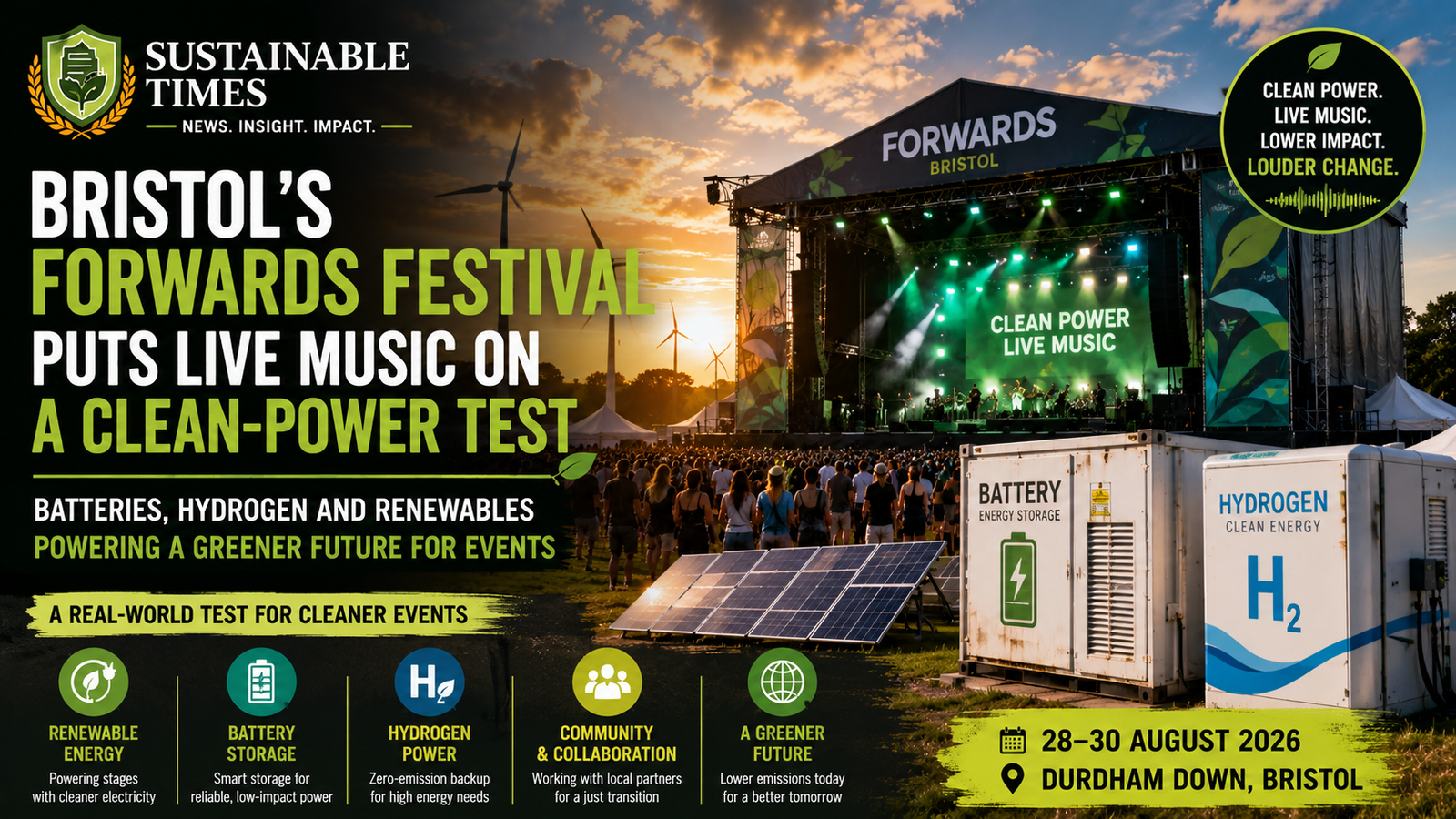
A music festival is usually associated with bright lights, huge speakers and a lot of energy consumption. This weekend, Bristol is trying to change that equation.
FORWARDS Festival, taking place in Bristol from 28–30 August, is becoming a major test case for cleaner power at large cultural events. The festival is using a combination of renewable electricity, battery storage and hydrogen-based power to reduce its dependence on conventional diesel generators.
The experiment matters because temporary events create a difficult sustainability problem: organisers need reliable electricity in locations where permanent grid connections may not be available.
FORWARDS is now asking whether cleaner temporary power can work at festival scale.
From Diesel Generators to Clean Power
Large festivals traditionally rely heavily on diesel generators to power stages, food stalls, lighting, production equipment and other infrastructure.
Bristol’s Clean Power Pilot is testing a different model.
The initiative has developed a dedicated clean-power hub at The Bottle Yard Studios, combining grid electricity with mobile battery systems and renewable power. Bristol City Council says the system can replace some diesel generators used for outdoor music festivals and film and television production.
The project grew out of the low-carbon ACT 1.5 concert in Bristol and has since expanded into a broader effort involving the West of England Combined Authority, Bristol City Council and ACT 1.5. The UK government’s music strategy identifies the pilot as an example of how the creative sector can move toward cleaner temporary power.
Batteries Become Part of the Festival Infrastructure
Battery storage plays an important role in the system.
Instead of running generators continuously, organisers can use batteries to store electricity and provide power when and where the event needs it.
The Clean Power Pilot has already demonstrated battery systems at film and television facilities and events around Bristol. Mobile battery units have powered stages, bars and catering operations at other local events, reducing the need for conventional generators.
That could make a significant difference at festivals.
Energy demand changes throughout the day. A battery can respond quickly to those changes while allowing organisers to bring in electricity from cleaner sources.
Hydrogen Adds Another Piece to the Puzzle
Batteries cannot solve every temporary-power requirement.
Some applications need longer-duration or higher-output power, particularly when organisers operate large stages and equipment for extended periods.
The FORWARDS setup therefore also incorporates hydrogen power, alongside battery systems and renewable electricity. The approach demonstrates how several technologies can work together instead of relying on one solution.
That combination could prove important beyond festivals.
Film sets, construction sites, outdoor events and emergency-response operations all need temporary electricity. If cleaner systems can deliver dependable power in these environments, the potential market extends far beyond the entertainment industry.
Why a Music Festival Matters for Sustainability
The environmental impact of festivals extends beyond electricity.
Transport, food, waste, water use and temporary infrastructure all contribute to an event’s footprint.
FORWARDS already describes sustainability as part of its broader mission and aims to develop greener practices across the festival experience. Its organisers say they want the event to create positive change beyond the performances themselves.
The clean-power project adds another layer: decarbonising the infrastructure that makes the event possible.
That is an important distinction.
Sustainability does not only mean asking audiences to recycle their cups or use public transport. It also means examining the energy systems operating behind the scenes.
Could This Change How Events Are Powered?
The biggest question is whether the model can scale.
A small outdoor event can experiment with batteries relatively easily. A major festival with multiple stages and thousands of visitors presents a much harder engineering challenge.
FORWARDS provides a useful real-world test because organisers must maintain reliable power while serving a large audience.
If the system performs well, it could give other festival organisers, film producers and event companies more confidence to replace fossil-fuel generators with cleaner alternatives.
The UK government has already identified the Clean Power Pilot as a potential model for expanding cleaner temporary power across cultural production. Its next phase plans to explore longer-term models for reducing dependence on diesel and other fossil fuels.
The Bigger Opportunity
The interesting part of this experiment is not simply that a festival can run on cleaner electricity.
It is that temporary infrastructure is becoming an important market for clean technology.
Battery manufacturers, hydrogen developers, renewable-energy companies and energy-management providers can potentially serve industries that have traditionally depended on diesel generators.
That creates a new sustainability opportunity: instead of treating temporary power as a niche problem, businesses can develop cleaner systems that work across multiple sectors.
Looking Ahead
FORWARDS begins its 2026 programme today, with the main two-day festival taking place on 29 and 30 August at Durdham Down in Bristol.
The event will be watched for its music, but its energy system may deserve just as much attention.
The clean-energy transition will not happen only through giant solar farms and offshore wind projects. It will also depend on replacing thousands of smaller fossil-fuel systems used every day across construction, entertainment, transport and industry.
Bristol is testing what that future could look like—one stage, battery and hydrogen system at a time.
Key Takeaway
Bristol’s FORWARDS Festival is testing a cleaner approach to temporary event power using renewable electricity, battery storage and hydrogen. If the model proves reliable at festival scale, it could help accelerate the replacement of diesel generators across the wider events, film and production industries.
About The Author