For decades, coral reefs could take a major hit from a bleaching event and still have enough time to recover.
That recovery window is now shrinking.
A major new assessment from the Global Coral Reef Monitoring Network (GCRMN) has found that the world’s coral reefs are being exposed to severe heat stress so frequently that many reefs no longer have enough time to rebuild between disturbances. The assessment draws on more than 40 years of monitoring, 21.1 million observations, 87,299 surveys and almost 37,000 reef sites across 124 countries, territories and economies.
The findings offer a worrying picture of ocean health, but they also reveal something important: coral reefs can still recover when conditions give them a chance.
The recovery window is disappearing
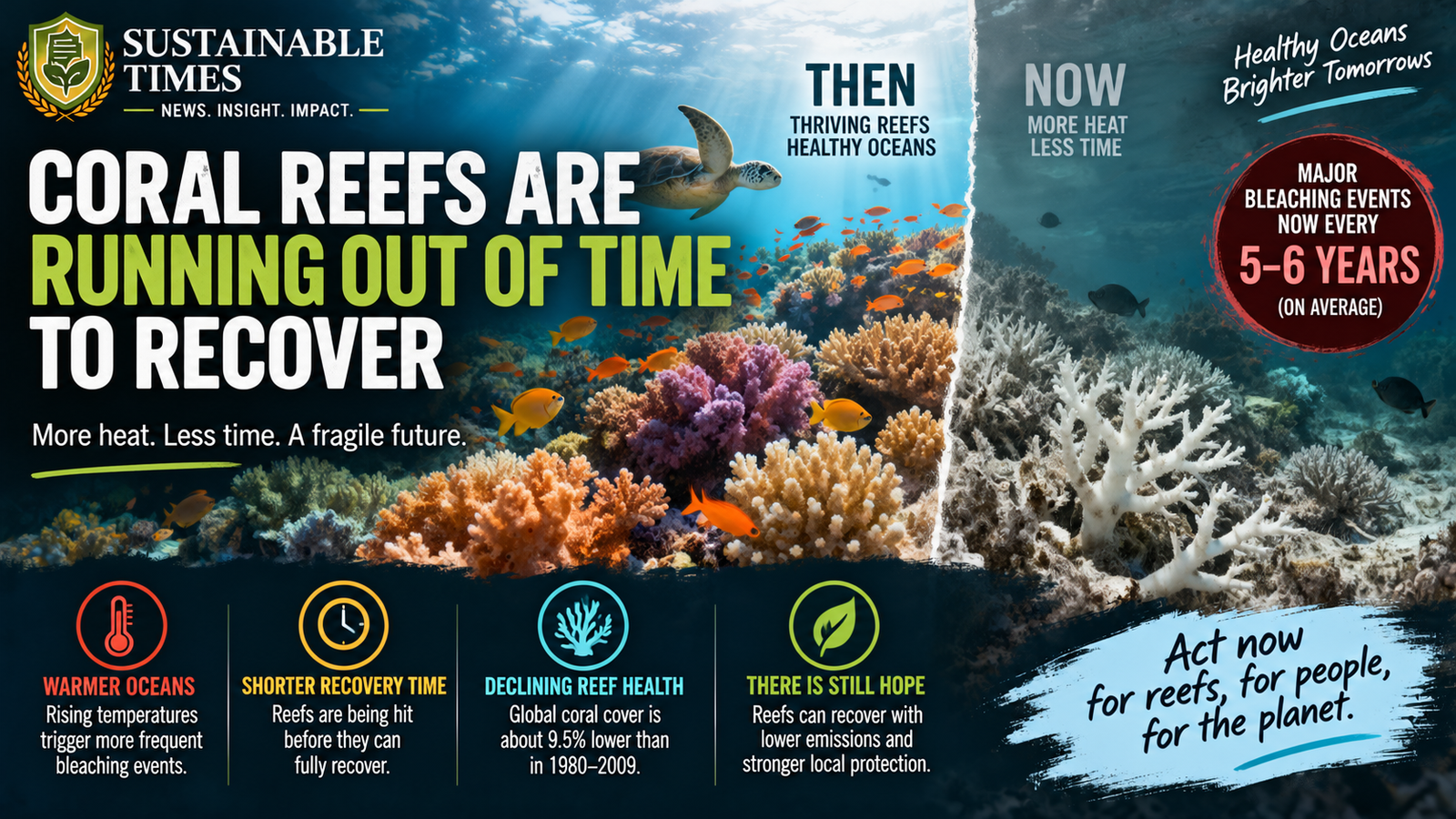
Global average hard coral cover in 2020–2024 stood about 9.5% below the 1980–2009 reference period, according to the new assessment. Climate-driven heat stress has become an increasingly important driver of coral loss.
The biggest change may be happening between bleaching events.
Major global bleaching events once occurred roughly a decade apart. Since 2010, major disturbances have been arriving approximately every five to six years. That creates a dangerous problem because many corals need several years to mature and reproduce.
In other words, reefs are increasingly being asked to recover before they have finished recovering.
2023 showed how large the threat has become
The assessment comes after the most extensive global coral bleaching event recorded to date.
The repeated exposure to unusually warm ocean temperatures places enormous stress on coral ecosystems. When temperatures remain elevated for too long, corals expel the microscopic algae that provide much of their energy, producing the familiar white appearance known as bleaching.
Bleaching does not automatically mean a coral reef is dead. If temperatures return to safer levels quickly enough, corals can recover.
The problem is frequency.
If another major heat event arrives before recovery is complete, coral colonies have fewer opportunities to rebuild. Over time, repeated disturbances can turn temporary damage into long-term ecosystem decline.
Climate change is not the only pressure
Ocean warming is the dominant global concern, but reefs also face local pressures.
Poor water quality, overfishing and coastal development can weaken reef ecosystems and reduce their ability to withstand climate-related stress. This means local conservation still matters even while governments work to reduce global greenhouse gas emissions.
That creates a two-level challenge.
The world needs to slow ocean warming through deep emissions reductions. At the same time, communities can improve water quality, manage fisheries, protect reef habitats and reduce other pressures that make already-stressed ecosystems more vulnerable.
There is still evidence that reefs can recover
The report is not simply a story of ecological decline.
Researchers have observed periods when coral cover increased after disturbances eased. That matters because it shows that conservation and climate action can still make a difference.
The University of Tasmania, whose researchers contributed to the assessment, notes that coral reefs have demonstrated recovery following disturbance in several regions. The uncertainty is whether those recovery patterns can continue as ocean temperatures keep rising and marine heatwaves become more frequent.
This is where climate policy and marine conservation meet.
Protecting reefs cannot depend solely on restoration projects after bleaching occurs. Restoration can help, but reefs ultimately need time without repeated extreme heat.
What happens next could determine which reefs survive
The message from the new assessment is surprisingly clear: humanity still has choices.
Cutting greenhouse gas emissions remains the most important long-term action because reducing ocean warming reduces the pressure driving mass bleaching. At the same time, stronger local management can give reefs greater resilience and improve their chances of recovering from disturbances.
For countries whose economies depend on fishing, tourism and healthy coastlines, this is not simply a biodiversity issue. Coral reefs support food systems, livelihoods and coastal protection for millions of people.
The question is therefore no longer just whether coral reefs can survive a warming world.
It is whether we can give them enough time to recover.
Key Takeaway
The world’s coral reefs are losing their recovery window as marine heatwaves become more frequent. Cutting emissions remains essential, but protecting reefs from local pressures can give them the resilience and breathing room they need to recover.
About The Author